WHAT DOES A UCL INJURY FEEL LIKE?
The short version
UCL pain is usually felt on the inside of the throwing elbow, but location alone cannot tell you whether the ligament is irritated, partially torn, or the wrong suspect entirely.

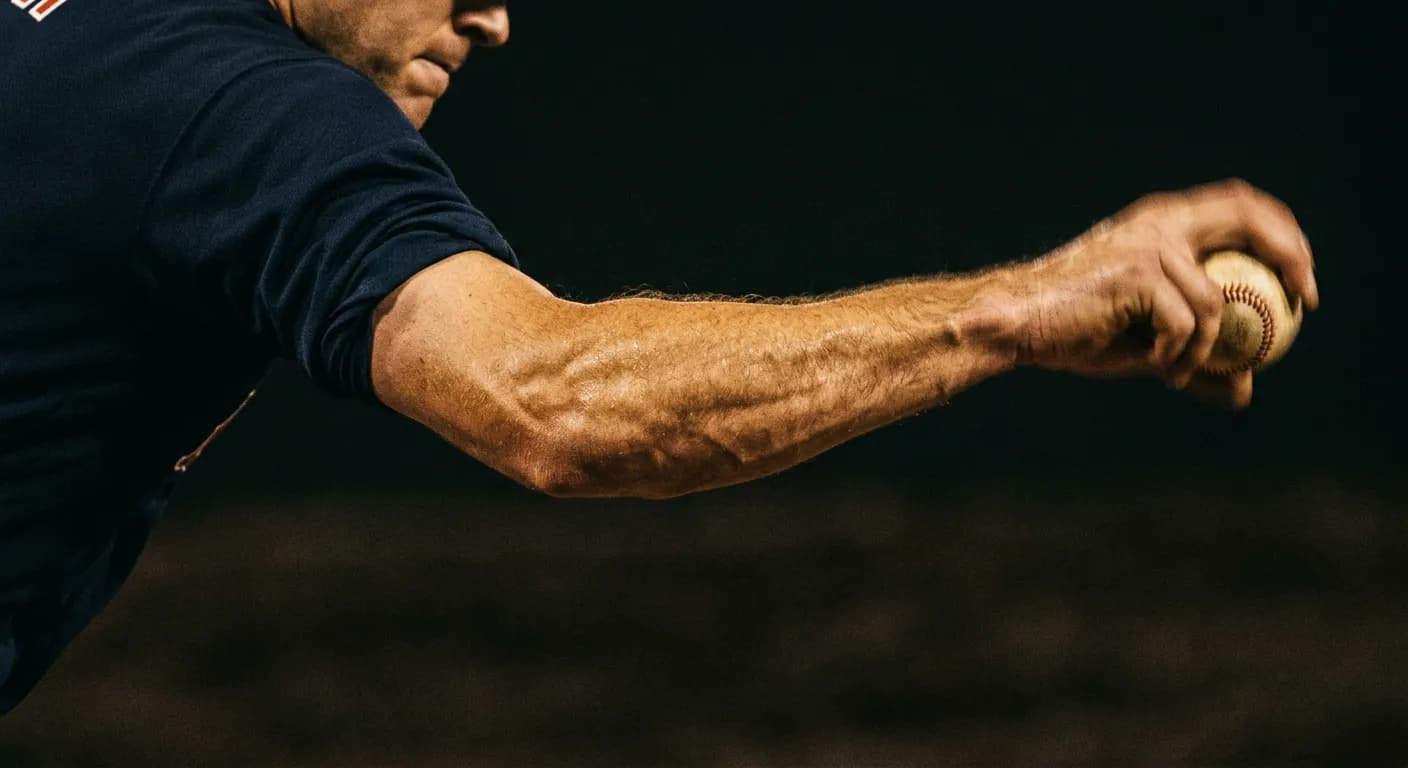
A pitcher walks in and points to the inside of his elbow. He felt one sharp pitch, lost a few miles per hour, and now the arm feels wrong when he gets near game intensity. The obvious fear is a torn UCL.
That concern is reasonable. It is not a diagnosis.
The flexor-pronator muscles, ulnar nerve, growth plate in a younger athlete, and posteromedial joint can all produce pain near the same patch of skin. A UCL injury also does not have one universal feeling. Some athletes describe a pop and immediate loss of function. Others report a gradual ache, poor command, or an arm that simply cannot tolerate the last 10 percent of effort.
Here is how we sort through it.
Where UCL Pain Usually Shows Up
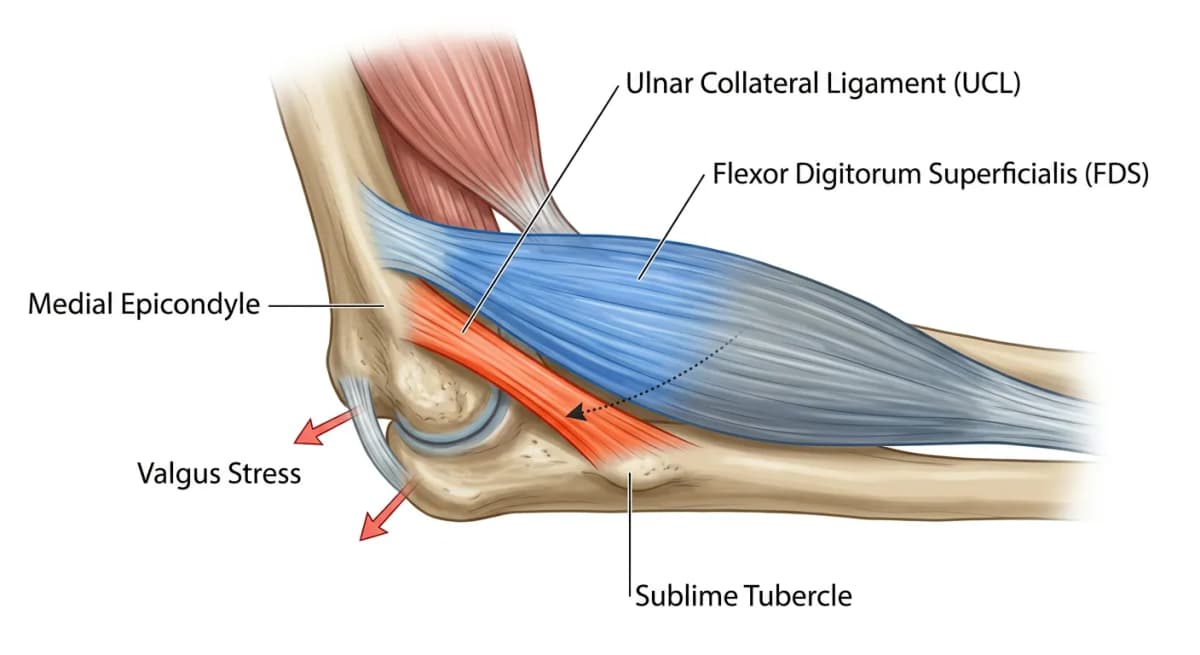
The UCL sits on the medial side of the elbow, the side closest to the body when the palm faces forward. Its anterior bundle is the primary ligament resisting valgus stress during the late cocking and acceleration phases of a throw.
Symptoms that increase suspicion include:
- pain directly along the inside of the elbow during high-effort throwing
- a sudden pop or tearing sensation
- pain as the shoulder reaches maximum external rotation
- loss of velocity, command, or confidence at higher intensities
- a sense that the elbow is unstable or cannot accept force
- tenderness along the ligament rather than only in the muscle mass below it
Those features matter most as a pattern. One positive item does not settle the question.
A Tear Does Not Always Begin With a Pop
The dramatic version gets attention: one pitch, one pop, game over. Plenty of UCL problems develop more quietly.
Repeated high-velocity throwing places valgus load across the elbow. The ligament shares that load with the flexor-pronator group and the way the rest of the body produces and transfers force. When throwing demand repeatedly outruns recovery and tissue capacity, a pitcher may first notice soreness that lasts longer than usual, declining command, or pain that appears only above a certain intent.
That is why the history matters. We want to know what changed in the previous days and weeks: pitch volume, intensity, weighted-ball work, position-player throws, recovery time, strength work, and any recent loss of shoulder or forearm capacity. A normal pitch count can still hide a large workload spike.
What Else Can Feel Like the UCL?
Medial elbow pain is a neighborhood, not a diagnosis.
The flexor-pronator mass can become painful where it originates near the medial epicondyle. This often hurts with resisted wrist flexion or pronation, although overlap with UCL symptoms is common. Forearm pain while pitching deserves a careful examination because the muscle group is also a dynamic stabilizer of the elbow.
The ulnar nerve may create burning, tingling, or electric symptoms into the ring and small fingers. Some athletes feel or hear a snap when the elbow bends. A snapping ulnar nerve can exist without major symptoms, so movement of the nerve is not automatically the source of pain.
Pain at the back of the elbow, especially near terminal extension, raises a different set of questions. Valgus extension overload can involve posteromedial impingement, osteophytes, loose bodies, or stress injury. In skeletally immature athletes, growth-plate injuries must stay on the list.
What the Examination Should Actually Test
A serious throwing-elbow evaluation should do more than press on the painful spot.
We compare elbow motion, shoulder motion, grip, wrist and finger flexion, pronation, and force production across multiple positions. We use ligament stress tests and assess whether symptoms appear under valgus load. We look for neurologic findings. We also test the trunk and lower body because the athlete has to produce and transfer force through the whole chain.
No single clinical test is perfect. Imaging can add useful information, but MRI findings must be interpreted beside the athlete's history and function. Throwers often develop structural adaptations that look abnormal in isolation. The question is not simply whether an image contains a signal change. The question is whether the tissue finding explains the athlete in front of us.
Does Pain Mean the UCL Is Torn?
No. Pain is a warning that the system cannot tolerate the current demand. It does not grade the ligament.
The practical decision is whether throwing is safe to continue while the cause is clarified. Throwing through escalating medial elbow pain, lost velocity, instability, or neurologic symptoms is a poor gamble. A mild symptom that settles quickly still deserves workload review and testing before it becomes a larger problem.
The complete UCL injury guide explains imaging, nonoperative care, surgical considerations, and return to throwing in more detail. The key first step is an accurate working diagnosis.
When to Get the Elbow Evaluated
Stop high-intensity throwing and seek an evaluation when pain changes mechanics, velocity, command, or willingness to accelerate the arm. A pop, bruising, obvious instability, persistent numbness, or symptoms that do not settle after a short recovery window deserve prompt medical attention.
An evaluation does not commit an athlete to surgery. In fact, identifying the tissue and injury location early can make conservative options clearer. A 2023 meta-analysis of nonoperative UCL care reported an overall return-to-sport rate near 80 percent, but outcomes differed sharply by tear location and injury grade. Proximal tears performed much better than distal tears. That is exactly why vague labels such as “elbow soreness” are not enough.
If your elbow hurts when you throw, the goal is not to prove or disprove a UCL tear from one symptom. The goal is to identify the painful structure, measure what the arm can tolerate, and make the next throwing decision with better information.
Athletic Potential provides baseball-specific physical therapy in Kent, Washington and Tampa, Florida, with strength testing, throwing progression, and coordination with the athlete's medical and coaching team.
THE NEXT STEP
See how diagnosis, tissue capacity, medical options, and throwing progression fit together after a UCL injury.
Explore UCL RehabRELATED POSTS
Can a Partial UCL Tear Heal Without Surgery?
Some partial UCL tears can return to high-level throwing without surgery. Tear location, tissue quality, symptoms, timing, and the demands of the athlete all change the answer.
 By Jason Modafari
Dry Needling for Throwing Shoulder Pain: Creating a Better Window to Train
Dry needling can reduce pain and guarding in a throwing shoulder, improve motion, and make strength work more productive. We use that response inside a full return-to-throwing plan.
By Jason Modafari
UCL Rehab Without Surgery: What Does It Actually Look Like?
Nonoperative UCL rehab is a criteria-based progression from calming the elbow to heavy strength work, plyometrics, throwing, mound exposure, and proof that the arm can recover.
 By Dylan Newcomer