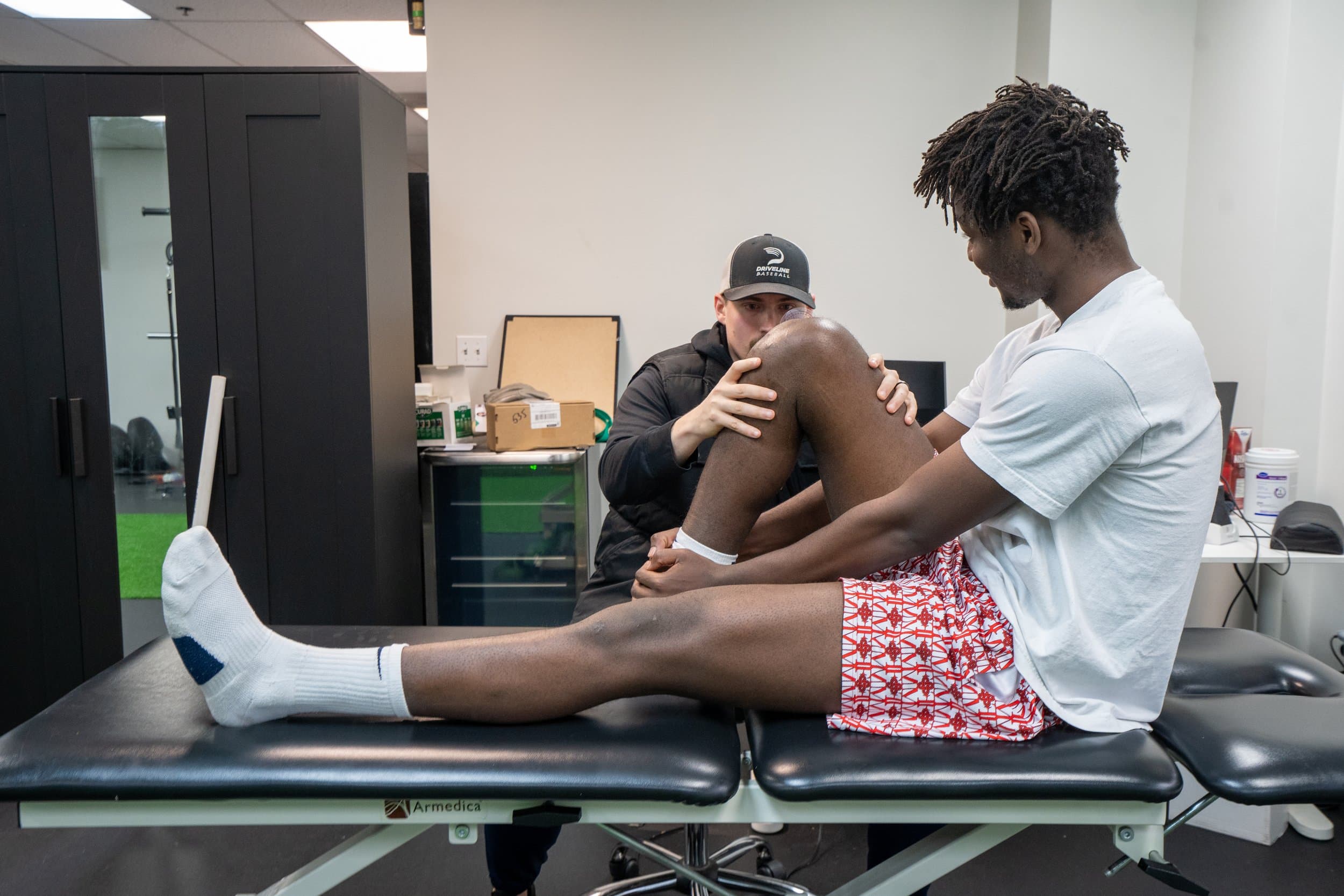
ACL Reconstruction Rehabilitation
Your surgeon said 9 months. The research says that's not enough.
Some studies report that as many as one in four young athletes sustain a second ACL injury after returning to cutting and pivoting sports. Risk is influenced by several factors, including age, sport, graft choice, rehabilitation, and whether objective return-to-sport criteria were met.
KEY FACTS
- How long does ACL rehab take for athletes?
- Competitive return often takes 9–12 months or longer. The surgery, associated procedures, strength, symptoms, movement, confidence, and sport demands can shift that timeline.
- What is the re-tear rate after ACL reconstruction?
- Studies report overall second-injury rates around 6–15%, with higher rates in some young athletes returning to cutting sports. Rates vary by population, and testing cannot eliminate risk.
- When can an athlete start running after ACL surgery?
- Running often begins around 12–16 weeks, but the surgeon protocol and clinical findings come first. Motion, swelling, quadriceps strength, gait, and the athlete’s response are commonly considered.
- Can an athlete return to cutting and pivoting sports?
- Many athletes return to cutting and pivoting sports after ACL reconstruction. Readiness is reviewed through a combination of healing time, clinical findings, strength, movement, training exposure, and confidence.
- What does ACL rehab cost?
- Individual physical therapy visits start at $135. Six-week Hybrid Plans start at $680 and can be projected across a longer recovery in the Plans calculator.
Why Most ACL Rehab Fails Athletes
Standard ACL rehab is designed to get you walking normally, climbing stairs without pain, and feeling stable in a straight line. For a 55-year-old who tore their ACL skiing and wants to garden comfortably, that is a fine outcome.
For an athlete who needs to plant, cut, decelerate from full speed, absorb contact, and repeat it 50 times in a game? It is nowhere close.
The typical insurance-based protocol runs 12-16 weeks of supervised PT. You do leg extensions, wall sits, balance board exercises, and maybe some light jogging. Your surgeon checks the box at the follow-up appointment. Everyone calls it a success.
Then you go back to your sport with a quad that is 30-40% weaker than the other leg, landing mechanics that are still asymmetric, and zero exposure to reactive agility. The re-tear statistics do not surprise us. The system is not built for your demands.
By the numbers
ACL rehab is hard. The data shows it.
Aggregate outcomes across thousands of reconstructions. The work to bend that average takes time, equipment, and patience most clinics don't get to spend.
55%
Return to competitive sport
Ardern et al., 2014
23%
Re-tear in young athletes within 5 years
Wiggins et al., 2016
13%
Of providers use objective return-to-sport criteria
Burgi et al., 2019
11–33%
Of patients actually meet RTS criteria when tested
Paterno 2018; Welling 2019
What we commit to
How we work to bend those numbers.
- Objective testing every phase (strength, hop, force plate, balance) not just at discharge.
- Hard discharge gates: 90%+ symmetry, force plate landing in tolerance, IKDC ≥ 90%. Non-negotiable.
- Return-to-sport phase past month six. Cleared on the calendar isn't the same as ready for the field.
- One-on-one sessions with your DPT and no insurance billing window cutting the rehab short.
“Mandatory regular testing and progress monitoring during rehabilitation cut ACL reinjury rates by half.”
Kotsifaki et al., British Journal of Sports Medicine, 2025
That's how we run it.
Rehab Is Training in the Presence of an Injury
From the first week after surgery, you are an athlete in training. Not a patient waiting to be fixed. Yes, the knee has constraints. But the rest of your body does not. Your upper body, your core, your opposite leg, your conditioning, all of it can and should be trained aggressively from the start.
By the time your knee is ready for heavy loading, you should not be deconditioned. You should be stronger than you were before surgery in every area except the surgical leg. That is the head start that separates athletes who return to form from athletes who spend another year trying to get back to baseline.
This is not traditional PT. You will squat, deadlift, lunge, press, and eventually sprint, jump, and cut. The loading is progressive, the criteria are objective, and the environment is a gym, not a clinic with a treatment table and a TENS unit.
Free phone consultation. No commitment, no insurance needed.
The Milestone Map
You advance when you earn it, not when the calendar says so. Every phase transition requires passing objective benchmarks.
Phase 1
Protect & Restore
Weeks 0-6
- +Reduce swelling
- +Restore full extension (critical)
- +Activate quad
- +Pain-free walking
Gate to Next Phase
Full passive knee extension matching opposite leg
Phase 2
Build Foundation
Weeks 6-12
- +Progressive loading
- +Single-leg strength
- +Full range of motion
- +Neuromuscular control
Gate to Next Phase
Single-leg press >50% body weight, full ROM
Phase 3
Strengthen
Months 3-6
- +Heavy compound lifts
- +Bilateral and unilateral strength
- +Proprioception training
- +Early running progression
Gate to Next Phase
Quad strength >70% LSI, running clearance criteria met
Phase 4
Power & Agility
Months 6-9
- +Plyometric progression
- +Change of direction
- +Sport-specific drills
- +Reactive agility
Gate to Next Phase
Hop testing >80% LSI, clean single-leg landing mechanics
Phase 5
Return to Sport
Months 9-12+
- +Full sport participation
- +Return-to-sport testing battery
- +Psychological readiness
- +Maintenance program
Gate to Next Phase
All RTS criteria passed: >90% LSI strength, >90% hop tests, sport-specific clearance
The Quad Strength Problem
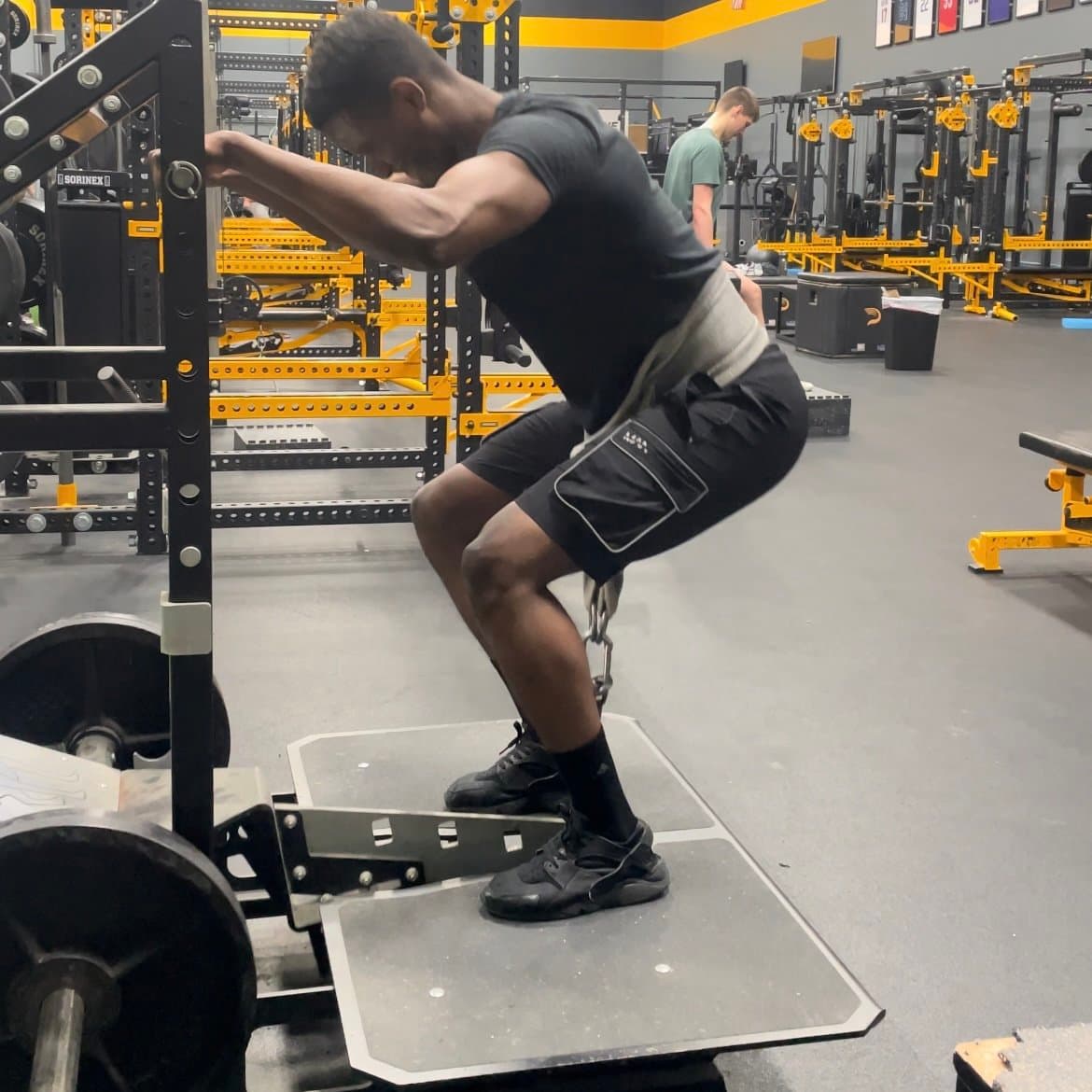
After ACL reconstruction, your quad shuts down. It is called arthrogenic muscle inhibition. The knee swells, the nervous system puts the brakes on quad activation as a protective mechanism. This is normal biology.
What is not normal is ignoring it for 6 months and hoping it resolves. Most rehab protocols do not measure quad strength until late in the process, if they measure it at all. By then, athletes have developed compensatory movement patterns (landing stiff-legged, shifting weight to the opposite side, avoiding deep knee flexion) that feel normal but are setting them up for re-injury.
We measure quad strength early and often. If your limb symmetry index is below target at any checkpoint, we adjust the program. You do not move on until the muscle catches up. This is not optional. It is the single most important variable in ACL rehab outcomes.
What “Cleared” Actually Means
Your surgeon clears the graft. We clear the athlete. These are different things.
Quad Strength
>90% Limb Symmetry
Tested via dynamometry at 60 and 300 deg/sec. Not estimated from leg press reps.
Hop Testing
>90% LSI (4 hop tests)
Single hop, triple hop, crossover hop, 6-meter timed hop. All four must pass.
Movement Quality
Symmetrical mechanics
Drop jump, single-leg squat, deceleration. Assessed for compensatory patterns.
Sport-Specific
Full practice tolerance
Graduated return through non-contact drills, controlled scrimmage, then full competition.
Built For Athletes Who
- +Plan to return to cutting, pivoting, or contact sports, not just daily life
- +Want objective benchmarks, not just time-based clearance
- +Are willing to put in 9-12+ months of serious work
- +Understand that rehab is training, not passive treatment
- +Have had surgery and want to come back stronger, not just "back"
- +Tore their ACL before and refuse to let it happen again
Not the Right Fit If
- -You want insurance-covered PT with multiple patients at once
- -Your goal is walking and stairs, not sport performance
- -You want to skip to running at 8 weeks because it "feels fine"
- -You are looking for passive modalities (ice, stim, ultrasound) as the primary treatment
Athletes we've worked with
Back on the field. In their words.
Mia R.
Soccer, D1 Commit
“I tore my ACL junior year and was told I would be back in 9 months. It took 11, and I am grateful for that. By the time I got back on the field, I tested stronger than before surgery on both legs. Most of my teammates who rushed back have dealt with problems since.”
James T.
Basketball, High School
“The hardest part was months 4-6 when I felt good but the testing said I was not ready. Looking back, that patience is what made the difference. My quad strength was nowhere near where it needed to be, even though my knee felt fine.”
Sarah K.
Lacrosse, Club
“My first ACL rehab at a regular PT clinic was mostly leg extensions and bike riding. When I tore the other knee, I came here. Completely different experience. Heavy squats, deadlifts, plyometrics, agility work. Actual training. Night and day.”
Already Torn One?
ACL Prevention Program
After ACL reconstruction, your opposite knee is at elevated risk. Our prevention program targets the modifiable risk factors (landing mechanics, strength ratios, and neuromuscular control) to protect both knees going forward.
Learn more →Ready to Test?
Return-to-Sport Testing
Not sure if you are ready to go back? Our return-to-sport testing battery gives you objective data on where you stand and what you still need to work on before competition.
Learn more →ACL rehabilitation
FREQUENTLY ASKED QUESTIONS
If you're deciding whether this fits, start here.
What it costs
The 6 Week Hybrid Plan.
Start with a 60-minute evaluation, then choose the number of one-on-one visits you need alongside an individualized six-week program.
Included in the price shown
SIX-WEEK REHAB + TOTAL-BODY PERFORMANCE PROGRAM
The $250 program covers the work you do between visits. It combines injury-specific rehab with total-body strength and performance training. With more frequent appointments, more rehab happens in person and the written plan shifts toward total-body performance. If you only want the visits, we can remove the program.
| Plan | Visits / 6 weeks | Follow-up rate | Program | Total |
|---|---|---|---|---|
| Hybrid 3 | 3 | $125 | $250 | $680 |
| Hybrid 6 | 6 | $120 | $250 | $1,030 |
| Hybrid 9 | 9 | $115 | $250 | $1,350 |
| Hybrid 12 | 12 | $110 | $250 | $1,640 |
| Hybrid 15 | 15 | $105 | $250 | $1,900 |
| Hybrid 18 | 18 | $100 | $250 | $2,130 |
See how totals are calculated
Every plan includes one $180 60-minute evaluation. The remaining visits use the follow-up rate shown above, and the $250 six-week program covers your work between appointments. The PT visit subtotal may be eligible for a superbill; the program fee is not.
The visit count includes one $180, 60-minute evaluation. The remaining visits are 45-minute follow-ups at the rate shown on each card. Pay in full or use an installment schedule across the six weeks.
INDIVIDUAL VISITS
Tune-ups, second opinions, and care between plans. No commitment.
See individual visit details- $135
- 45-minute visit
- $180
- 60-minute evaluation or extended visit
HSA and FSA cards are accepted for eligible expenses. Eligibility and reimbursement depend on the plan and service. Superbills may be available for eligible PT visits. Program fees are not PT encounters.
Both run with Dylan in Kent, WA or Jason in Tampa, FL. Cash-based practice; superbills available for out-of-network reimbursement. HSA/FSA cards are accepted for eligible expenses.
Stop rehabbing for “good enough.”
Whether you are one week post-op or six months into a program that does not feel like it is preparing you for your sport, we can evaluate where you are and build a plan around the work still ahead.
Book a Free Consult