UCL sprain or tear
Where: Inside of the elbow
When: Late cocking and acceleration; worse at higher intent
Feel: Sharp and specific; sometimes a pop
Throwing Elbow Rehabilitation
One-on-One
Evaluation with a Doctor of PT
Specific
UCL, forearm, nerve, and joint testing
Objective
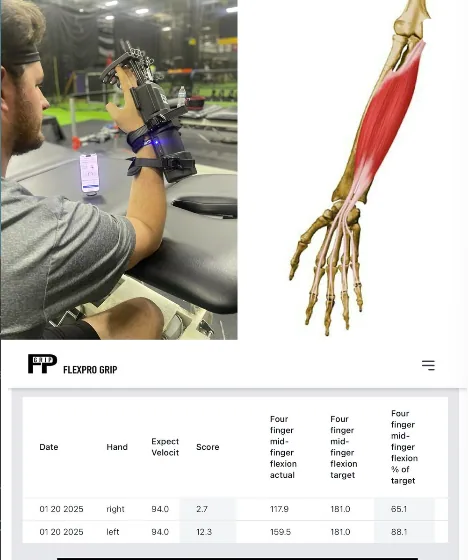
Grip, strength, velocity, and workload
Complete
Rehab through return to competition
KEY FACTS
These patterns can overlap, so the table is a starting point—not a diagnosis. Location, timing, symptoms, strength, motion, and workload all matter.
Possible source
Where
When
Typical feel
Where: Inside of the elbow
When: Late cocking and acceleration; worse at higher intent
Feel: Sharp and specific; sometimes a pop
Where: Inside and slightly forward
When: Gripping, wrist flexion, warm-up throws
Feel: Muscular ache or burning that may warm up
Where: Behind the inner elbow into the ring and pinky fingers
When: After throwing, at rest, or with the elbow bent
Feel: Tingling, numbness, electric pain, or hand weakness
Where: Back of the elbow
When: Release and full extension
Feel: Pinching, catching, locking, or loss of extension
Where: Outside of the elbow
When: Gripping, batting, wrist extension, or release
Feel: Persistent burning or sharp ache
Most elbow pain in throwers comes down to the same equation: stress applied exceeded tissue capacity. But the specific tissue that failed, and the treatment for each, is completely different. Misidentifying the problem wastes months. Here is how to start narrowing it down based on where it hurts, when it hurts, and what it feels like.
Where it hurts: The inside (medial) part of your elbow, right on the bony bump or just below it. Some people describe it as “deep inside” the elbow rather than on the surface.
When it hurts: During late cocking and acceleration, the moment your arm is laying back and then whipping forward. This is when valgus stress (the force trying to open the inside of your elbow) is highest. Pain usually spikes on max-effort throws rather than playing catch.
What it feels like: Sharp, sudden, and specific. Not vague. You can usually point to the exact spot with one finger. A partial tear might feel like a “twinge” that gets worse with velocity. A complete tear often comes with a pop and immediate inability to throw.
The key question: Does it hurt more when you throw harder? UCL injuries are velocity-dependent because valgus torque scales directly with ball velocity, not arm action or mechanics. Playing catch at 60% might feel fine, but when you let it go, the pain shows up because the load exceeds what the tissue can handle.
Where it hurts: Also medial, which is why it gets confused with UCL injuries constantly. The pain sits slightly more on the muscle belly, just below and forward of the medial epicondyle. It can feel more “muscular” than “ligament-y.”
When it hurts: During acceleration like a UCL issue, but also during gripping, wrist flexion, and sometimes just carrying heavy things. The key difference: it often hurts during warm-up throws and then settles down, whereas UCL pain tends to worsen as you ramp up intensity.
What it feels like: More of a burning or aching sensation than the sharp, specific pain of a UCL sprain. The area might feel stiff in the morning or after periods of rest. Grip strength may feel reduced.
The key question: Does squeezing a ball or making a fist reproduce the pain? Flexor-pronator issues are load-sensitive through the forearm muscles, not just through the throwing motion.
Where it hurts: The inside of the elbow, but with a twist. Literally. The ulnar nerve runs through a groove behind the medial epicondyle (your “funny bone”). Pain or tingling often radiates down the forearm into the ring finger and pinky.
When it hurts: This one is sneaky. It might not hurt during throwing at all. Instead, you notice numbness or tingling in your hand after throwing, at rest, or when sleeping with your elbow bent. Some throwers feel it snap or “sublux” over the bone during the throwing motion.
What it feels like: Electric, tingling, or “dead”. Very different from the muscular or ligamentous pain of the other conditions. Your ring finger and pinky might feel numb, weak, or like they're falling asleep. Some athletes notice decreased grip strength or trouble controlling the ball.
The key question: Do you have tingling or numbness in your ring and pinky fingers? If yes, ulnar nerve irritation is one possibility and deserves a closer examination.
Where it hurts: The back (posterior) of the elbow, specifically around the olecranon, the bony point you lean on. This is the opposite side from UCL pain, which is an important distinction.
When it hurts: During deceleration and follow-through, not acceleration. The moment after ball release, when your elbow snaps into extension and the olecranon jams into the fossa. Repeated valgus stress combined with forced extension creates bone spurs and impingement over time.
What it feels like: A locking or catching sensation at full elbow extension. You might feel like you can't fully straighten your arm, or that something is “blocking” at end range. It often develops gradually over a season rather than as a single acute event.
The key question: Do you have difficulty fully extending your elbow, or does it catch or lock? VEO is a mechanical problem (bone hitting bone) and it has a distinct mechanical feel.
Where it hurts: The outside (lateral) part of the elbow. Less common in throwers than medial pain, but it happens, particularly in position players who are also batting heavily, or in athletes with extensor overload from grip-intensive training.
When it hurts: Gripping, wrist extension against resistance, and sometimes during the release phase of throwing. Batting can aggravate it significantly. Unlike medial issues, lateral pain often shows up more during everyday activities: opening jars, shaking hands, turning doorknobs.
What it feels like: A burning or sharp ache on the outside of the elbow that worsens with gripping or lifting with the palm down. The area may be tender to touch. It tends to be persistent, the kind of pain that just... doesn't go away without intervention.
The key question: Does it hurt when you grip something firmly or lift with your palm facing down? If yes, the wrist extensors are likely involved.
Here is the honest answer: you probably can't tell from a website. These conditions overlap. UCL sprains and flexor-pronator tendinitis live in the same neighborhood. Ulnar nerve issues often coexist with UCL damage. Valgus extension overload is sometimes the downstream consequence of chronic medial instability.
What you can do is use the descriptions above to have a better conversation with your provider. “My elbow hurts” is vague. “I have sharp medial pain during acceleration that worsens with velocity and I can point to it with one finger”. That tells a clinician almost everything they need to know to start.
A focused evaluation uses specific clinical tests, strength measures, range of motion, workload history, and throwing information. The goal is to identify which tissue is involved and what it can currently tolerate.
From Evaluation to Competition
Calming pain answers the first question. The rest of the plan rebuilds the strength, speed, workload, and sport exposure your elbow has to tolerate when the game speeds up.
01
Use the pain pattern, clinical testing, throwing history, strength, motion, and workload to understand what is irritated and why.
02
Load the elbow and forearm while maintaining full-body strength, then add faster and more explosive work as the arm earns it.
03
Progress throwing intensity, volume, pitch mix, mound work, and competition exposure while monitoring symptoms, velocity, and recovery.
An evaluation with a throwing-focused physical therapist gives you a clear clinical explanation, a treatment plan, and the benchmarks that will guide your return to throwing. A referral is typically not needed to start.
Book a Free Consult