WHAT A SERIOUS THROWING-ARM EVALUATION SHOULD MEASURE
The main point
A useful throwing-arm evaluation connects symptoms, workload, motion, shoulder and forearm strength, ultrasound when appropriate, and the demands of the athlete's role.

Table of Contents
- Start with the throwing story
- Map the symptoms before chasing a diagnosis
- Measure motion in context
- Test strength in the positions that matter
- Peak force is not the only strength question
- Forearm testing belongs in an elbow evaluation
- Where ArmCare fits
- What diagnostic ultrasound can add
- Reproduce the baseball demand when it is safe
- Retest after a relevant dose
- Testing before return to throwing
- Testing before the mound
- A number should change a decision
A throwing-arm evaluation should answer a decision.
Can the athlete keep throwing? Which tissue appears irritated? Does the current workload fit the arm's capacity? Is the player ready to begin a return-to-throw program, move to the mound, or increase bullpen intent?
Collecting numbers without a decision turns testing into decoration. Skipping measurement leaves too much to guesswork.
The useful middle is a focused battery that matches the athlete, the injury, and the next baseball demand.
Start with the throwing story
The history often explains more than the first strength test.
We ask:
- Where is the pain?
- Which phase of throwing brings it on?
- Does it change with intent, distance, pitch type, or volume?
- What happens later that day and the next morning?
- Has velocity, command, or endurance changed?
- What did the athlete throw during games, warm-ups, bullpens, long toss, pull-downs, weighted-ball work, and position play?
- Did the player change teams, roles, pitch mix, training phase, or weekly schedule?
- What injuries, imaging, injections, or operations came before this episode?
“My elbow hurts” is a starting point. Pain at maximum external rotation after a recent velocity jump tells a different story than posterior pinching at release after a dense bullpen week.
Map the symptoms before chasing a diagnosis
The exact location, depth, timing, and behavior help narrow the possibilities.
Inside-elbow pain can involve the UCL, flexor-pronator group, ulnar nerve, growth plate, or nearby bone and joint. Posterior pain can fit valgus extension overload. Lateral pain raises a different set of questions. Shoulder symptoms can involve the cuff, labrum, biceps, instability, internal impingement, nerve irritation, or workload.
We also screen for symptoms that change urgency: a pop, bruising, major swelling, loss of motion, persistent numbness, hand weakness, visible muscle loss, or a sudden unexplained drop in velocity.
Measure motion in context
Throwing shoulders adapt. The dominant arm commonly gains external rotation and loses some internal rotation. Humeral retroversion can account for part of the side-to-side difference.
A 2025 systematic review of chronic shoulder adaptations in pitchers reported an average clinical internal-rotation deficit of 10 degrees and external-rotation gain of 6.5 degrees across 1,101 professional pitchers in the included studies. The review also found that isolating soft-tissue restriction changed the interpretation of the apparent deficit (Paul et al., 2025).
That is why we do not label every internal-rotation difference as a problem.
Motion testing may include:
- shoulder internal and external rotation at 90 degrees
- total rotational arc
- horizontal adduction
- shoulder flexion
- elbow flexion and extension
- forearm pronation and supination
- wrist motion
- neck and upper-back motion when symptoms suggest it
- hip motion when the broader throwing pattern or lower-body complaint calls for it
The comparison includes side-to-side values, the athlete's previous baseline when available, symptoms, role, and changes across the season.
A meta-analysis found associations between deficits in throwing-arm total motion or internal rotation and arm injury in baseball populations (Bullock et al., 2018). Association does not turn one range measurement into a prediction. It tells us that motion belongs in the larger risk and capacity picture.
Test strength in the positions that matter
Manual muscle testing can detect a large weakness. It often cannot tell us enough about a high-level throwing athlete.
Handheld or fixed dynamometry gives force data that can be repeated over time. We may test:
- shoulder external and internal rotation in neutral
- rotation at 90 degrees of abduction
- shoulder elevation in several angles
- elbow flexion and extension
- grip strength
- wrist flexion and extension
- pronation and supination
- individual finger flexion when medial elbow or forearm symptoms are present
Protocol matters. Position, stabilization, lever arm, instructions, device placement, and tester strength can change the number.
A systematic review of handheld shoulder dynamometry found generally sufficient relative reliability, while measurement error varied and individual change required careful interpretation (Chamorro et al., 2021). A 2026 review reached a similar conclusion and emphasized standardized positions, fixation, timing, instructions, and encouragement (Minder et al., 2026).
The lesson is practical. Use the same protocol. Look at trends. Do not overreact to a tiny change that may sit inside measurement error.
Peak force is not the only strength question
Throwing happens quickly, and the arm must repeat effort. A maximal isometric value tells one part of the story.
Depending on the stage and equipment, we may also review:
- rate of force development
- repeated-contraction drop-off
- strength after throwing
- force at longer lever arms
- force in overhead positions
- grip and finger-force fatigue
- side-to-side response across the session
A 2025 study of the Athletic Shoulder Test in baseball players found good reliability for peak force and more variability in early rate of force development. The authors recommended repeated measures when interpreting the faster metric (baseball ASH test study).
Fast measures can be useful. They need more than one trial and a consistent setup.
Forearm testing belongs in an elbow evaluation
The flexor-pronator group contributes muscular support to the medial elbow. Grip alone does not capture every part of that system.
When the case calls for it, we may compare:
- whole-hand grip
- individual finger flexion
- wrist flexion
- forearm pronation
- pain during each test
- peak force and repeated-effort response
FlexPro Grip can help separate finger contributions and track force. The tool is useful because it makes the test repeatable, not because a device can diagnose the UCL.
Combined UCL and flexor-pronator injuries occur. A study of 99 injured baseball players found a combined injury in 45, with flexor digitorum superficialis involvement in 40 of those 45 cases (Ikezu et al., 2022). The cohort was selected for injury and imaging, so those figures should not be treated as prevalence in every pitcher with forearm pain.
Where ArmCare fits
ArmCare provides portable strength testing and can support repeated measures across rehab or a throwing phase. We may use it to compare force between sides, positions, sessions, or workload changes.
The value comes from the question attached to the test:
- Did shoulder strength improve during rehab?
- Does force fall after a throwing session?
- Is the athlete maintaining capacity as bullpen workload rises?
- Did a recent flare change the profile?
A readiness score should not overrule symptoms, healing constraints, workload, or the exam. The measurement joins the decision.
What diagnostic ultrasound can add
Diagnostic ultrasound can visualize the UCL and surrounding structures. Stress ultrasound can measure ulnohumeral joint space at rest and under a standardized valgus load.
Long-term studies show why interpretation matters. In 368 asymptomatic professional pitchers, the dominant UCL was thicker and the stressed joint space was wider than the nondominant side. Hypoechoic areas and calcifications were also more common in the throwing arm (Atanda et al., 2014). Throwing creates adaptation.
A later longitudinal study of 203 professional pitchers found some group differences in relative resting joint space and hypoechoic foci, but dominant-arm thickness, stressed joint space, and laxity did not cleanly separate the pitchers who required UCL reconstruction that season (2024 stress-ultrasound study).
Ultrasound can answer focused questions about tissue appearance and joint-space response. It cannot promise an injury-free season or decide progression by itself.
Reproduce the baseball demand when it is safe
The clinic exam should eventually connect to throwing.
That may involve:
- low-intent catch
- selected constraint drills
- radar to anchor intensity
- video to connect symptoms with the delivery
- PULSE or another workload record
- flat-ground throwing
- mound progression
- bullpen volume, intent, and pitch mix
We do not start with high-intent throwing when the tissue or symptoms make it unsafe. Later, avoiding the task leaves a gap between testing and competition.
Retest after a relevant dose
A rested baseline is useful. Some problems appear only after workload.
Retesting may ask whether motion, shoulder force, grip, finger flexion, pain, or nerve symptoms change after catch play or a bullpen. The next-morning response adds another layer.
The purpose is to find a repeatable signal. One bad rep or one unusually good day should not rewrite the whole plan.
Testing before return to throwing
The athlete does not need a perfect score in every category. The important question is whether the tissue is ready for the first throwing dose and whether the rest of the arm can support it.
We review:
- healing and procedure restrictions
- daily symptoms
- required motion for the current stage
- shoulder, elbow, and forearm strength
- tolerance for plyometric or faster arm work
- lower-body and trunk training
- the planned throwing dose
- how the response will be tracked
The return-to-throwing program then becomes another test that builds capacity.
Testing before the mound
Mound work changes the context. The slope, approach, intent, command, and pitch-specific demands raise the cost of a bad progression.
Before the mound, we want repeatable flat-ground throwing, predictable recovery, stable strength, and a defined first bullpen. The first session needs a plan for pitch count, intent, pitch mix, rest between throws, and what will happen next if the athlete responds well.
A number should change a decision
Testing earns its place when it answers one of four questions:
- What appears limited now?
- Did the intervention change it?
- Did throwing change it?
- Is the athlete prepared for the next demand?
More data is not automatically better. Better questions make the data useful.
Athletic Potential provides detailed throwing elbow, throwing shoulder, and baseball physical therapy evaluations in Kent, Washington and Tampa, Florida. Testing is selected around the athlete's symptoms, stage, and baseball role. Book a free consultation to discuss what needs to be answered.
THE NEXT STEP
Find the clinical or performance path that best matches your injury and sport.
Explore Sports RehabRELATED POSTS
Workload, Fatigue, and Pain: What to Track Before Adding More
Training numbers are useful, but they do not tell the whole story. Combine workload, recovery, symptoms, and performance when adjusting a rehab or throwing plan.
 By Dylan Newcomer
What Does a UCL Injury Feel Like?
UCL pain is usually felt on the inside of the throwing elbow, but location alone cannot tell you whether the ligament is irritated, partially torn, or the wrong suspect entirely.
By Dylan Newcomer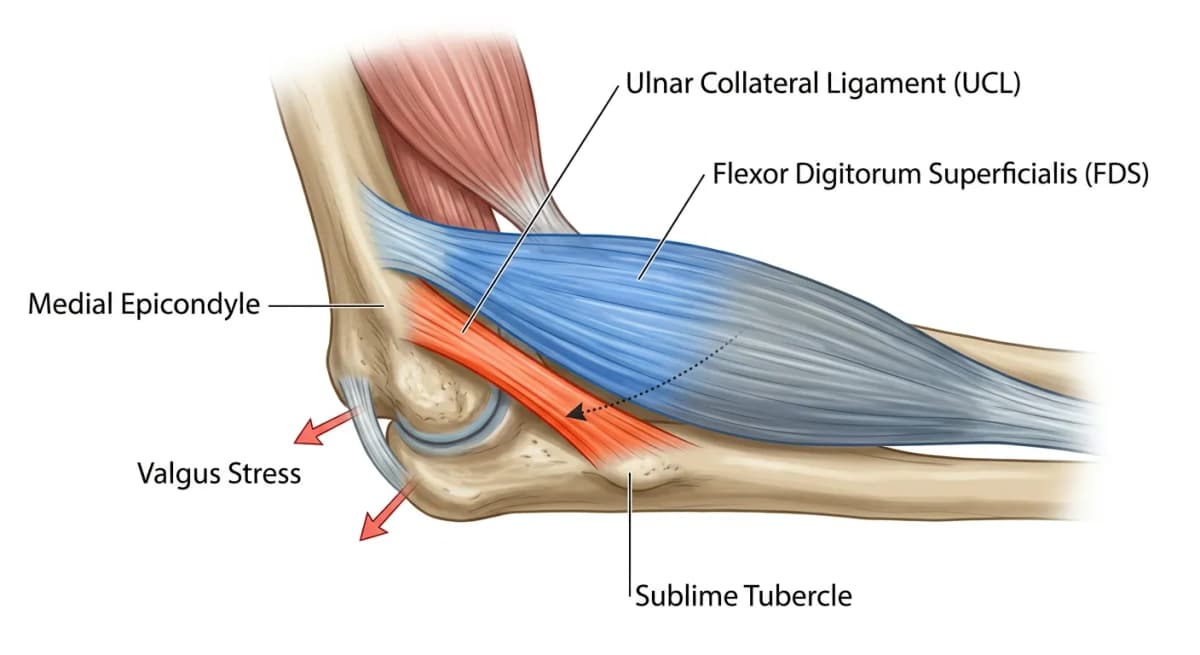
Can a Partial UCL Tear Heal Without Surgery?
Some partial UCL tears can return to high-level throwing without surgery. Tear location, tissue quality, symptoms, timing, and the demands of the athlete all change the answer.
 By Jason Modafari