SHOCKWAVE THERAPY FOR ACHILLES AND PLANTAR FASCIA PAIN
The short version
Shockwave can reduce pain and improve function in selected Achilles and plantar heel conditions. We pair it with calf, foot, and running progressions so the relief carries into daily life and sport.


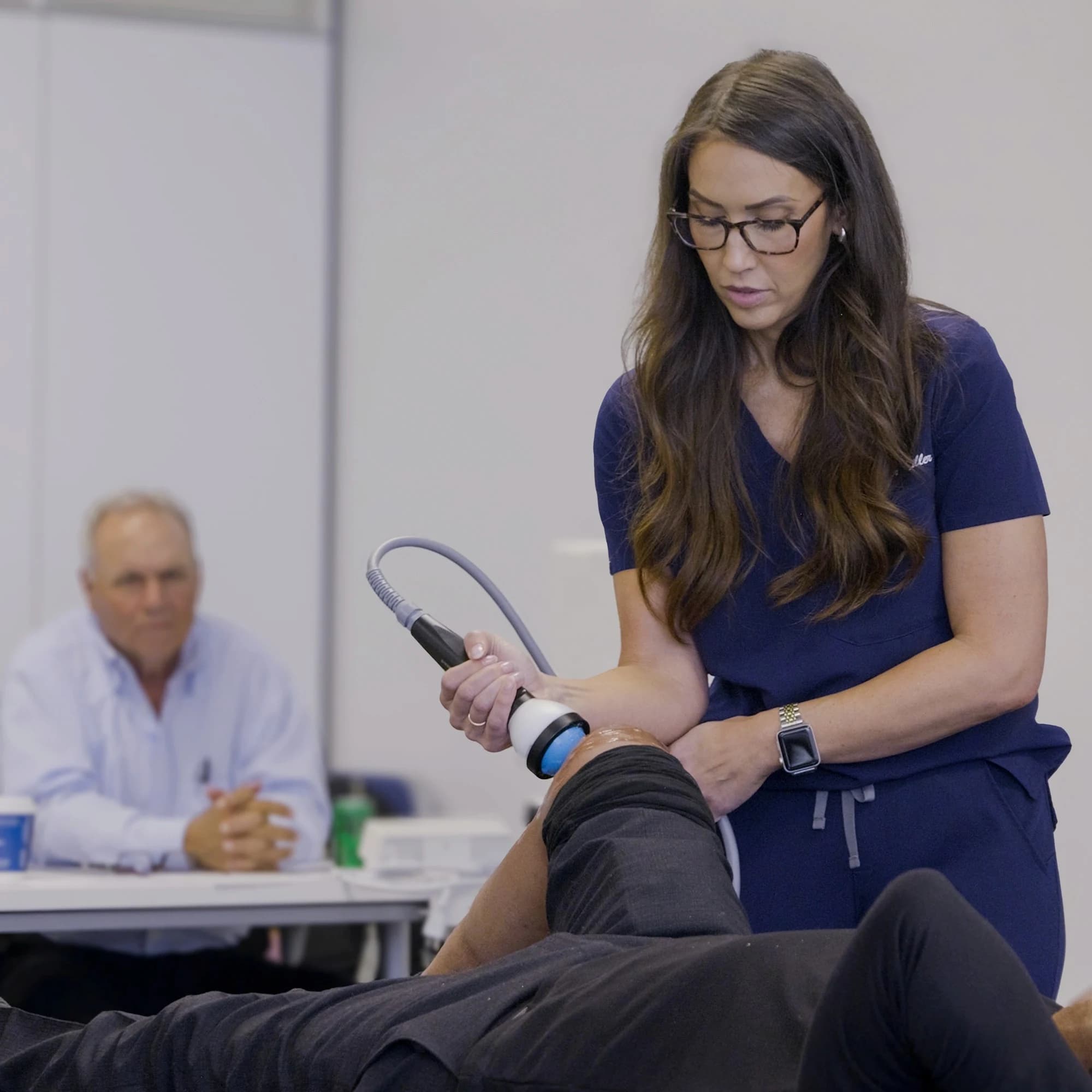
Morning heel pain and Achilles stiffness can outlast stretching, rolling, rest, shoe changes, and several attempts at strengthening. The first steps of the day hurt. Running takes longer to warm up. Progress stalls at the same distance or speed.
Shockwave can be a strong next step for selected cases. It gives the painful area a focused mechanical stimulus while the athlete continues to build calf and foot capacity. The treatment is noninvasive, takes only part of a visit, and requires little interruption to daily activity.
Start With the Source of Heel Pain
Plantar fasciopathy commonly causes pain near the inside of the heel, often worst with the first steps after rest. Nerve irritation, fat-pad pain, bone stress, and referred pain can create similar symptoms.
A 2024 meta-analysis of shockwave for plantar fasciitis reported improvements in pain and function. Dose and protocol influenced the results, which makes a planned course of treatment and consistent reassessment important.
For someone whose first-step pain has lingered despite good basic care, shockwave offers a way to reduce symptoms without an injection while we keep building tolerance for walking, standing, or running.
Achilles Location Matters
Midportion Achilles pain and insertional pain behave differently. Compression near the heel can make deep dorsiflexion poorly tolerated in insertional cases, while a midportion tendon may accept that range earlier.
Achilles outcomes vary more. Some reviews and trials support shockwave, while a 2026 sham-controlled trial did not find an added benefit in its study population. We use the diagnosis, tendon location, prior loading history, and early response to decide whether the treatment deserves a place.
What Shockwave May Change
The acoustic pulses create a mechanical signal inside the treated tissue. Laboratory and clinical research suggests that this signal may affect pain sensitivity, blood-vessel signaling, cell activity, collagen turnover, and other parts of tissue remodeling. The response develops over time, which is why shockwave is usually delivered as a series rather than judged after one visit.
Patients often care about simpler changes. Morning steps hurt less. A calf raise feels more comfortable. Walking or running volume starts to climb again. Those are the signs we track.
Loading Turns the Change Into Capacity
Both conditions respond best when the treatment sits inside a plan that restores calf and foot capacity. We may begin with isometrics or modified ranges, progress to heavy calf work, and then add faster stretch-shortening demands such as running, jumping, or cutting.
For insertional Achilles pain, exercise range may be modified early to reduce compression. For plantar heel pain, footwear, total standing and walking volume, and intrinsic foot capacity may influence the dose.
Where Shockwave Fits
Shockwave may be considered when symptoms remain persistent despite a credible loading program, when pain repeatedly blocks progression, or when an athlete wants a noninvasive option before considering an injection. It pairs naturally with exercise because there is usually no need to pause the larger rehab plan.
We track morning symptoms, walking tolerance, calf strength, hopping or running exposure, and the athlete's actual goal. Tenderness alone is not the outcome.
What the Exercise Progression Should Include
For an irritable Achilles tendon, isometric calf work or a limited-range heel raise may be a tolerable entry point. Load then rises through standing and seated calf work because the gastrocnemius and soleus both matter. Single-leg force, speed, and elastic work follow. A runner ultimately needs hopping and running exposure; calf strength in the clinic is not the endpoint.
Plantar heel pain also benefits from building calf and foot capacity. We may modify walking or running volume temporarily, review footwear, and progress loaded heel raises or foot-strength tasks. The plan should reduce the gap between what the foot can tolerate and what daily life or sport requires.
Symptoms can fluctuate during loading. We do not require zero discomfort on every repetition, but pain should remain within the agreed range and settle predictably. Rising morning pain across several days usually signals that the total dose needs adjustment.
Common Reasons Treatment Stalls
Complete rest can calm symptoms while lowering capacity. Stretching into compression may irritate an insertional Achilles. A return to full running before restoring calf force can recreate the original overload. At the other extreme, an exercise program can be so light that it never challenges the tissue enough to adapt.
A better program still matters. Shockwave can make that program easier to tolerate and help a patient move through a plateau that has lasted for months.
What to Expect
Treatment usually involves several sessions, with dosage adjusted to the device, diagnosis, and tolerance. Some soreness can follow. The bigger change often appears across several weeks as pain settles and the athlete handles more load.
We reassess the same markers throughout the series. Better morning symptoms, stronger calf work, and more walking or running tell us the process is gaining traction.
Athletic Potential offers shockwave as part of sports physical therapy in Kent and Tampa. The treatment targets the painful tissue. Our rehab process builds the capacity to run, train, and compete on it again.
THE NEXT STEP
See how hands-on treatment, progressive strength work, and return-to-sport planning fit into one rehabilitation process.
Explore Sports Physical TherapyRELATED POSTS
Shockwave Therapy for Tennis and Golfer's Elbow
Shockwave can reduce persistent elbow tendon pain and improve grip tolerance. We combine it with wrist, grip, and forearm loading that prepares the arm for work or sport.

 By Dylan Newcomer and Jason Modafari
Shockwave Therapy for Chronic Tendon Pain: How It Can Restart Progress
Shockwave gives a stubborn tendon a focused mechanical stimulus that may reduce pain and support tissue remodeling. We pair it with progressive loading to turn symptom change into better function.
By Dylan Newcomer and Jason Modafari
Dry Needling vs Cupping vs Manual Therapy: Which Tool Fits Your Rehab?
Dry needling, cupping, and manual therapy can each reduce pain or improve movement. We choose the tool that creates the best opening for strength and sport-specific work.
By Jason Modafari