DEAD ARM IN BASEBALL: FOUR CAUSES, ONE NOBODY CATCHES
The short version
"Dead arm" is not one thing. It's four different problems — and the most underdiagnosed one is caused by a coaching cue every pitcher has heard.
By Dylan Newcomer, PT, DPT
Table of Contents
- The Four Types of Dead Arm
- Why Workload-Based Dead Arm Happens
- Thoracic Outlet Syndrome: The One Nobody Catches
- Functional TOS: The Upper Trap Problem
- Structural TOS: When Conservative Care Fails
- When Dead Arm Is Actually Your UCL Failing
- The SLAP Lesion: The Original "Dead Arm"
- How to Tell the Difference
- What to Do About It
"My arm feels dead."
If you have spent any time around baseball, you have heard this. A pitcher comes out of a start and says his arm felt heavy, his velo was down, the ball had no life. The catch-all diagnosis: dead arm.
The problem is that "dead arm" is not a diagnosis. It is a symptom description that covers at least four distinct problems, each with different mechanisms, different timelines, and different treatments. Lumping them together under one label means the actual cause gets missed — sometimes for months, sometimes for an entire career.
Here is what dead arm actually is, how to tell the difference between the four types, and why one of them is being systematically created by a coaching cue every pitcher has heard since they were twelve years old.
The Four Types of Dead Arm
Before we go deeper, here is the overview. When a pitcher says his arm feels dead, he is describing one of these four things:
1. Workload-based fatigue. The most common by a wide margin. The arm is tired because of accumulated throwing volume. It resolves with appropriate rest and workload management.
2. Thoracic Outlet Syndrome (TOS). Compression of the nerves and blood vessels that run from the neck into the arm. Massively underdiagnosed in baseball. This is the focus of the post.
3. Early UCL insufficiency. The ligament is failing gradually before the acute rupture. Velocity declines over weeks or months. By the time the pitcher feels a pop, the UCL has been degrading for a while.
4. SLAP/labral pathology. The classic "dead arm syndrome" as originally defined by Burkhart et al. (2000) — a Type 2 SLAP lesion causing posterosuperior instability and sudden loss of arm speed during the acceleration phase of throwing.
Each of these feels like "dead arm." Each requires a completely different approach. And number two — TOS — is the one getting missed more than any other.
Why Workload-Based Dead Arm Happens
This is the most common version, and it comes down to a simple equation: the throwing stress you applied exceeded what your arm was prepared to handle. That is a volume and intensity problem, not a tissue pathology problem.
The concept that matters here is the acute-to-chronic workload ratio (ACWR) — the ratio of what you threw recently (last week) compared to what you have been throwing on average (last four weeks). The research supports keeping that ratio between 0.8 and 1.3. Spike above that range and injury risk climbs.
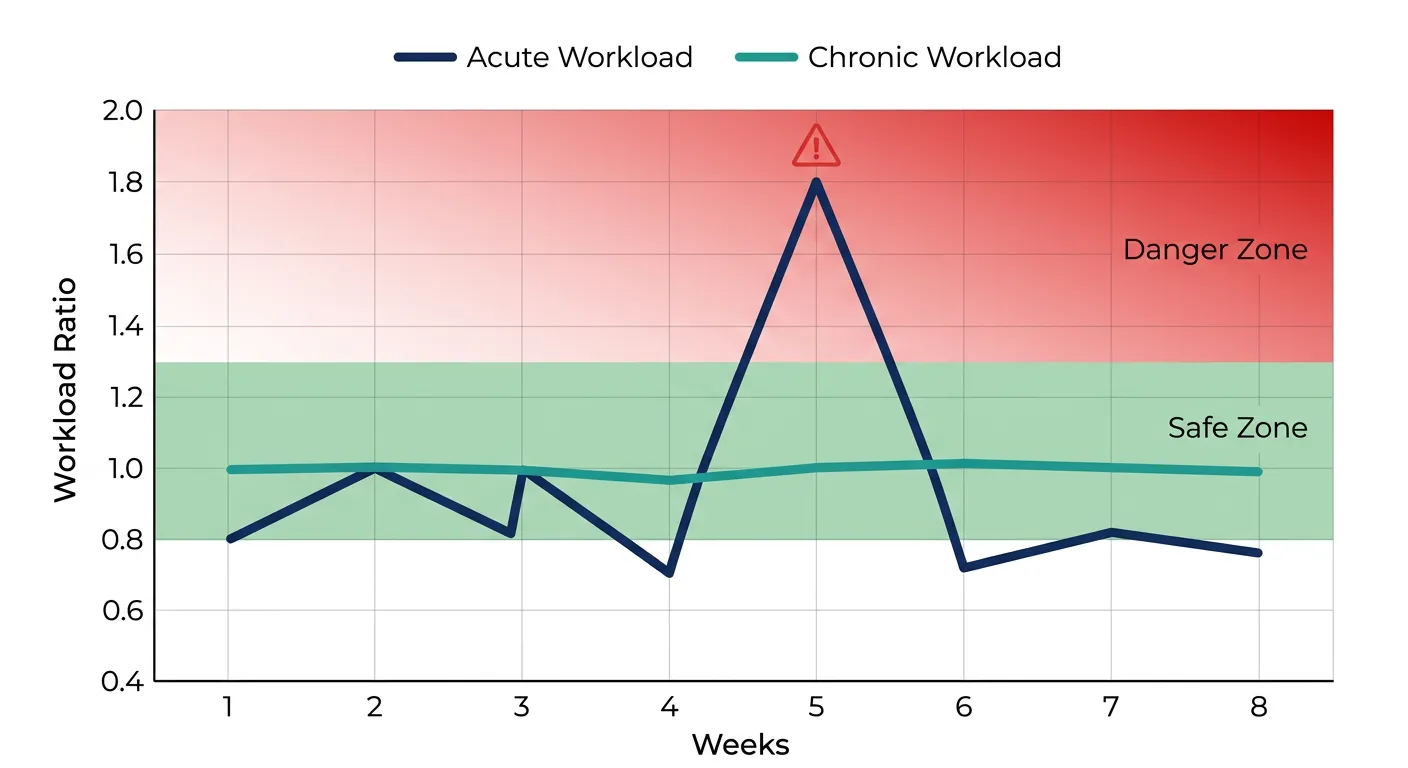 Acute vs. chronic workload ratio over 8 weeks — the acute workload spikes into the danger zone above 1.3 at week 5 while the chronic workload stays flat around 1.0.
How do you actually track it? Wearable sensors like PULSE — a forearm-mounted IMU — capture every throw, not just the ones in a game. Throw count, arm speed, estimated stress per throw. Because we practice inside Driveline Baseball, our athletes have access to this tech daily. For athletes without wearable tech, a simple throwing log works: date, throw count, estimated intensity (low/medium/high), and session type. Less precise, but a basic log catches the dangerous spikes that no log at all will miss.
Pitch count alone is a terrible proxy for workload. Dowling et al. (2020) found that 42% of game-day throws — warm-ups, bullpen sessions, between-inning tosses — are not even counted toward pitch limits. Regularly pitching with fatigue creates 36 times greater odds of injury requiring surgery. Pitchers exceeding 80 pitches per game had 4x greater surgery risk.
And "dead arm" is not always an arm problem. Tremblay et al. (2024) showed that lower body fatigue produces velocity loss comparable to upper body fatigue. A pitcher with dead legs can present with dead arm. The fatigue is systemic — the arm just gets the blame.
Here is what I actually see with pitchers who come in with workload-based dead arm. It is almost always one of these patterns:
Their lows become mediums and their mediums become highs. Recovery days stop being recovery days. A light catch play session creeps up to 80% intent. A bullpen that was supposed to be a feel session turns into a velo session. Over weeks, the athlete loses the low end of their intensity spectrum entirely, and every throw becomes moderate-to-high stress. The arm never gets a real down day.
They spike volume or intensity without a ramp. A pitcher takes three weeks off over winter break, then shows up to preseason and throws 60 high-intent pitches on day one. His acute workload just went from near-zero to game-level stress. The ACWR is through the roof. The arm was not prepared for that jump, even if it "felt fine."
They spike volume at high intensities. This is the subtle one. A pitcher might throw the same total number of pitches week to week, but the percentage of those pitches thrown at high intent creeps up. Forty throws at 70% and forty throws at 95% are not the same session. Volume alone does not capture the stress. Intensity matters.
Their chronic workload is too low. This is the other end — the pitcher who barely throws outside of game days. He plays catch twice a week, maybe, and then goes out and throws 80 competitive pitches. His arm has no chronic base to absorb that acute load. He is essentially spiking every time he takes the mound because his between-start throwing volume is so low that game day is always a relative overload.
The fix for workload-based dead arm is workload management — not rest. If you rest completely, your chronic base drops even further, and the next time you throw at intensity you spike again. The goal is to build and maintain a chronic throwing base that makes game-day demands a manageable portion of your overall workload, with genuine recovery days built in that stay recovery days. If dead arm resolves with appropriate load management, it was workload. If it does not, you need to look deeper.
Thoracic Outlet Syndrome: The One Nobody Catches
Thoracic outlet syndrome is compression of the brachial plexus (the nerve bundle) and/or the subclavian artery and vein as they pass from the neck into the arm. There are three spaces where this compression can occur: the interscalene triangle (between the scalene muscles in the neck), the costoclavicular space (between the clavicle and first rib), and the subcoracoid space (under the pec minor).
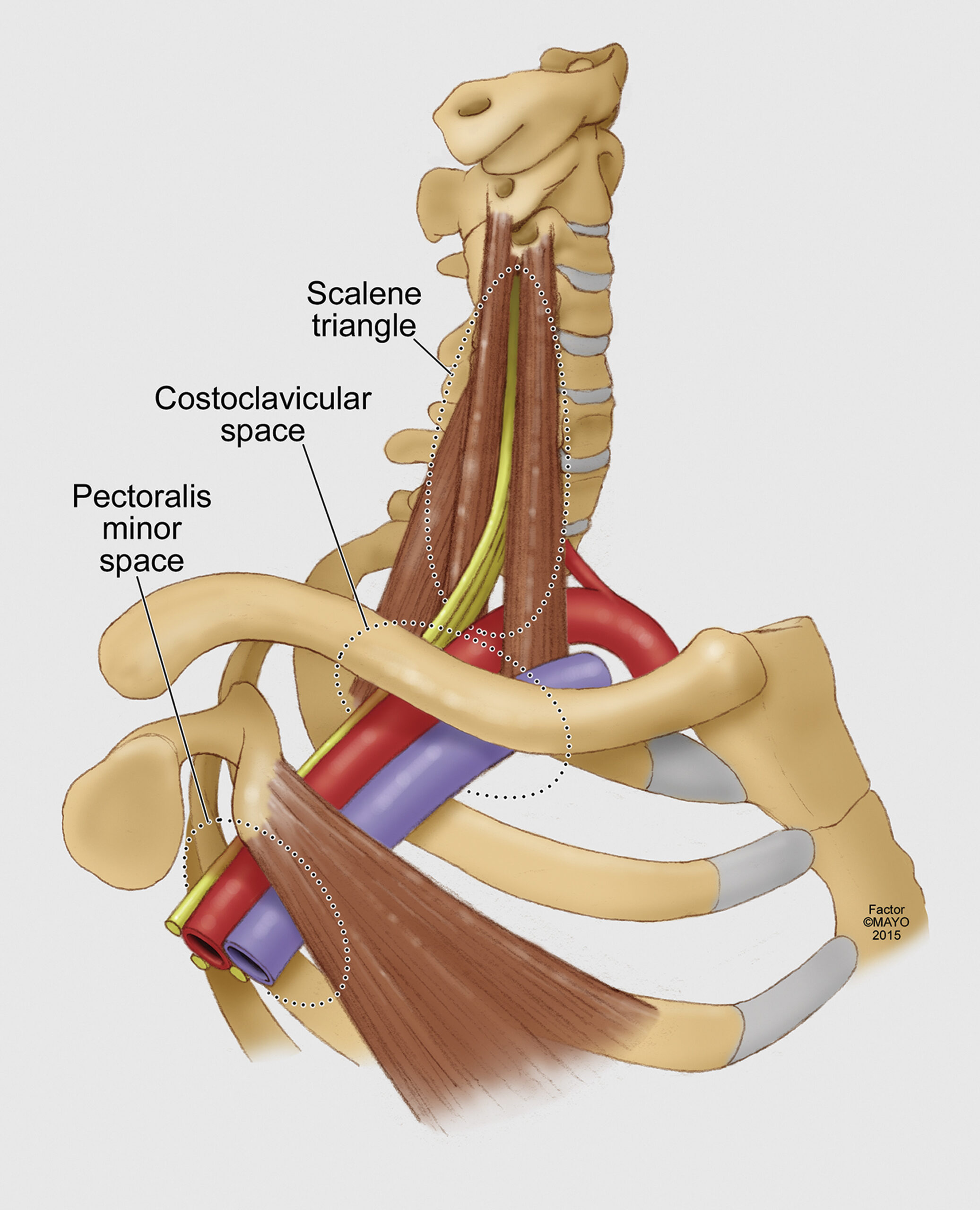 The three thoracic outlet compression sites — scalene triangle, costoclavicular space, and pectoralis minor space — with the brachial plexus and subclavian vessels passing through each.
Garraud et al. (2022) conducted a systematic review of TOS in sport and found that baseball pitchers are the most vulnerable population. Neurogenic TOS — compression of the nerves rather than the blood vessels — accounts for roughly 90% of cases. Vascular TOS makes up the remaining 5-10% but is a different animal clinically; the dead arm sensation in throwers is almost always neurogenic.
And here is the problem: nTOS is what Troyer et al. (2023) call "a diagnosis of exclusion." There is no single definitive test. You rule out everything else first, and then maybe someone thinks to check for TOS.
That diagnostic ambiguity means it gets missed constantly. A pitcher complains of arm heaviness, numbness in the ring and pinky fingers, loss of velocity that does not follow workload patterns. He gets told to rest. He rests. It does not get better. He gets an MRI of the shoulder. It is clean. He gets scoped anyway. Nothing changes. Months later, someone finally tests for thoracic outlet compression.
This happens in the major leagues. It happens far more often in college and high school, where fewer people are even thinking about TOS as a possibility.
I see two fundamentally different presentations of TOS in throwers, and the distinction matters because the treatment is completely different.
Functional TOS: The Upper Trap Problem
This is where baseball's culture is actively creating pathology, and almost nobody is talking about it.
Of the three compression sites described above, the costoclavicular space is the most anatomically susceptible based on cadaveric analysis. When that space narrows, nerves and blood vessels get compressed. Symptoms: numbness, tingling, heaviness, loss of velocity, dead arm.
What opens the costoclavicular space? Clavicular elevation. What closes it? Clavicular depression.
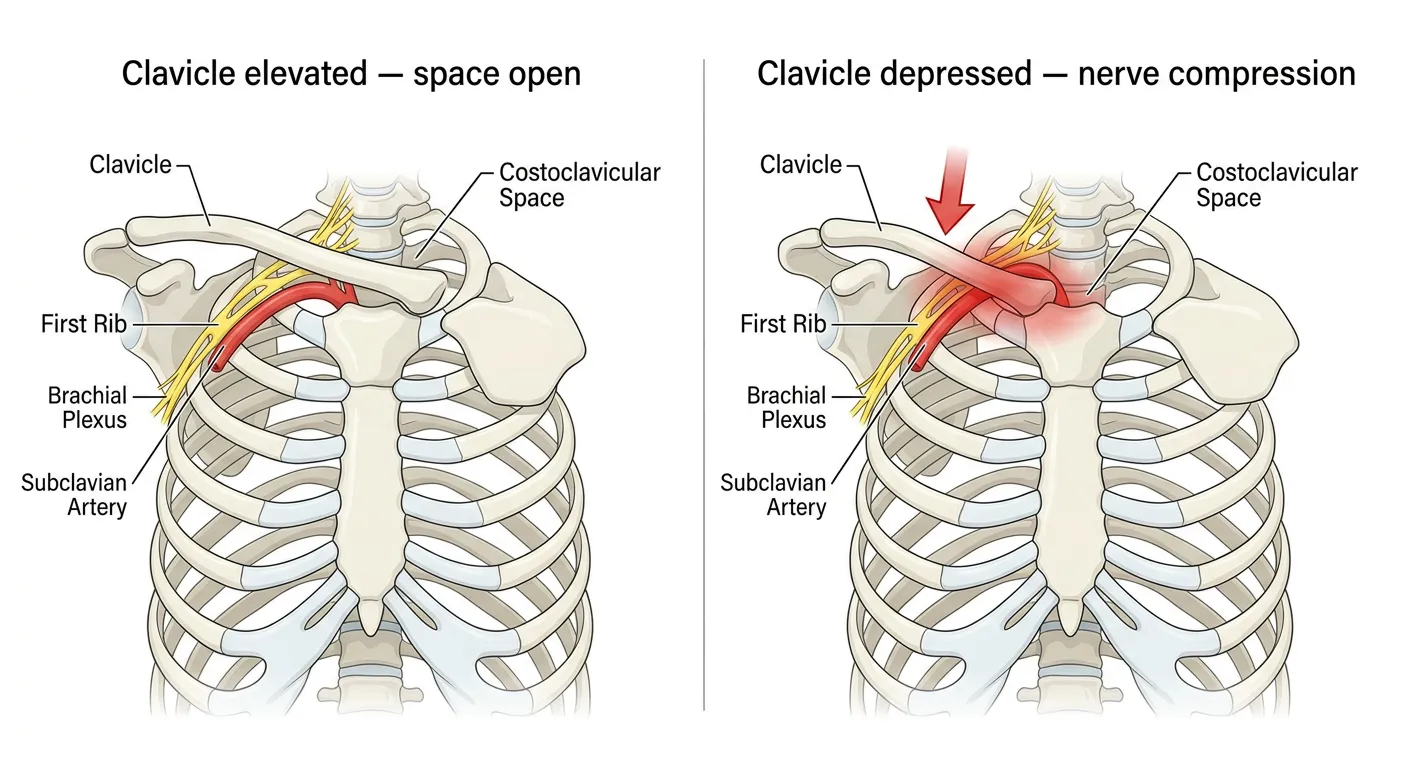 Costoclavicular compression mechanism — left shows the clavicle elevated with the space open and neurovascular bundle passing freely, right shows the clavicle depressed with nerve compression between the clavicle and first rib.
Now here is the question nobody in baseball is asking: which muscle elevates the clavicle?
The answer is the upper trapezius — and it is essentially the only one. Camargo and Neumann (2019) confirmed that the upper trapezius attaches distally only to the clavicle, not the scapula. Its primary action is clavicular elevation through rotation at the sternoclavicular joint. Johnson et al. (1994) reinforced this: the upper trap fibers "draw the scapula and clavicle backwards or raise the scapula by rotating the clavicle about the sternoclavicular joint."
This is important. The levator scapulae — which sounds like it should be relevant here — elevates the scapula, not the clavicle. It does not directly open the costoclavicular space. The upper trap is the primary muscle responsible for lifting the clavicle off the underlying structures.
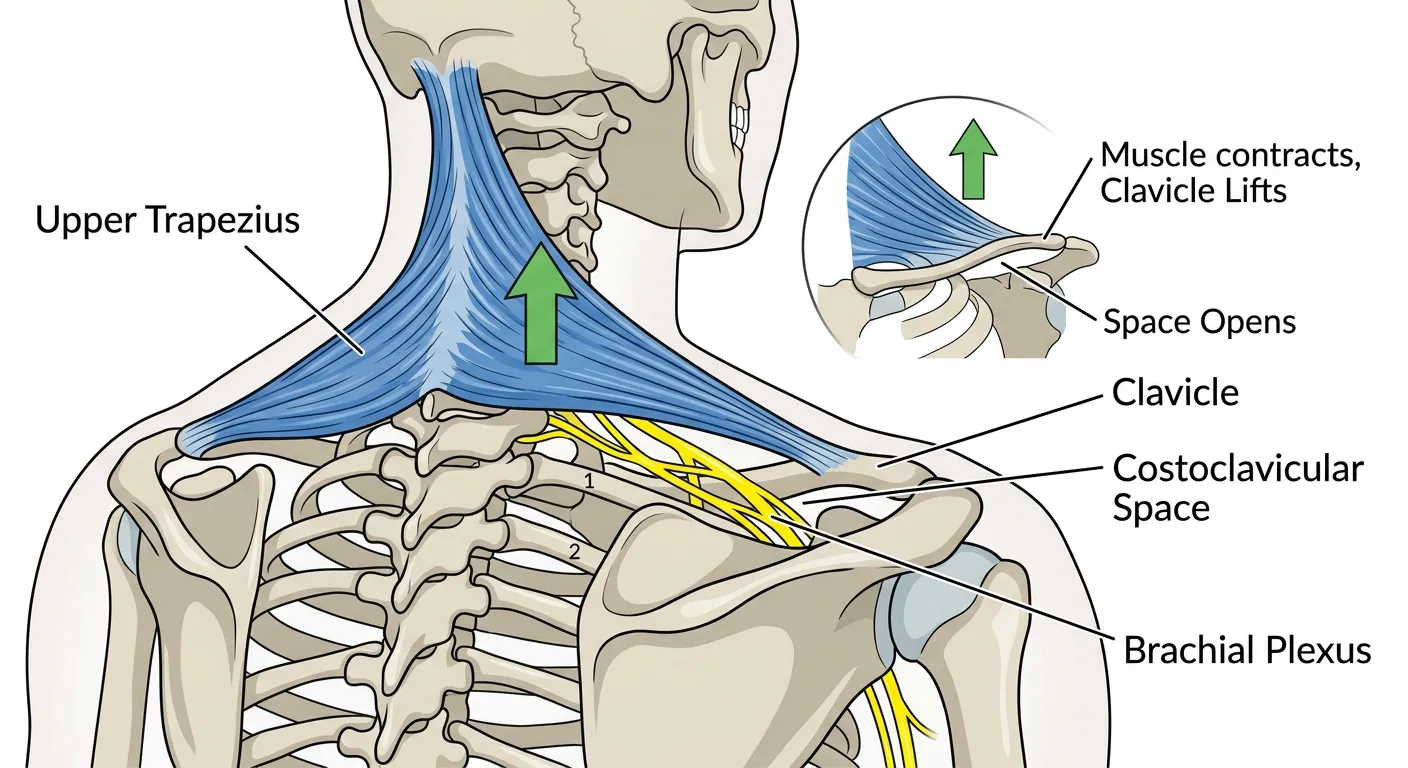 The upper trapezius fibers attach from the occiput and cervical spine to the lateral clavicle — when they contract, the clavicle lifts and the costoclavicular space opens.
And the upper trapezius is one of the most demonized muscles in baseball.
"Shoulders down and back." Every pitcher has heard this cue from a coach, a trainer, a well-meaning parent. Keep the shoulders down. Do not shrug. Shrugging is bad. It means you are tense. It means you are compensating. It means your mechanics are wrong.
Larsen (2018) published what I consider the most important paper on this topic that nobody in baseball has read. The common postural cue to pull the shoulders back and down biomechanically replicates the Halstead costoclavicular compression test — also called the military brace position. This is the clinical test used to provoke TOS symptoms. You push the shoulders down and back, and if the patient develops numbness, tingling, or loss of pulse, the test is positive for costoclavicular compression.
Read that again. The coaching cue "shoulders down and back" is literally the clinical test for costoclavicular TOS. Baseball is teaching pitchers to hold a position that clinicians use to reproduce thoracic outlet compression.
When you systematically inhibit the upper trapezius — the one muscle responsible for elevating the clavicle and opening the costoclavicular space — you create a chronically depressed shoulder girdle. Levine and Rigby (2018) documented that a depressed and anteriorly shifted shoulder leads to decreased costoclavicular space and increased friction on the neurovascular bundle. Lokman et al. (2024) identified Droopy Shoulder Syndrome — abnormally low shoulder positioning — as "a rare but crucial precursor to thoracic outlet syndrome." Their treatment? Strengthening the trapezius. Shoulder shrugs were explicitly recommended.
The research on TOS rehabilitation tells the same story. Hock et al. (2024) published current clinical guidelines for TOS rehab in the Journal of Athletic Training and recommended axillary-sling taping to create scapular elevation and upward rotation. The goal is to bring the shoulder girdle up, not push it down. Luu et al. (2022) reviewed the TOS exercise rehabilitation literature and found that Watson's influential protocols specifically addressed the "dropping shoulder" and emphasized elevating the shoulder girdle to decompress the thoracic outlet. Watson et al. (2010) established graded restoration of scapular control and positioning as the foundation of conservative TOS management.
The implication is hard to ignore: baseball's anti-shrug culture may be creating the exact postural environment that leads to functional TOS.
The Nuance That Matters
I want to be precise here, because the relationship between the upper trap and the costoclavicular space is not as simple as "more upper trap equals more space."
Philp et al. (2024) published a case report of upper trapezius hypertonicity — specifically trapezius dystonia — causing TOS by pulling the distal clavicle superiorly and posteriorly, narrowing the costoclavicular space from above. When the overactive trapezius was treated with Botox, the symptoms resolved.
So upper trap hypertonicity can also cause TOS. The mechanism is different — the clavicle gets pulled up and back so aggressively that it compresses from the top rather than from below — but the end result is the same: a narrowed costoclavicular space.
This is not a contradiction. It is a reminder that the issue is appropriate tone and balance, not simply maximizing upper trap activation. Both too little and too much upper trap tone can compress the costoclavicular space, just through different mechanisms.
But here is the relevant clinical context: in baseball, the predominant problem is not excessive upper trap tone. It is insufficient upper trap tone from years of being told not to shrug, from coaches cueing shoulders down and back, from a culture that treats upper trap activation like a mechanical flaw. The typical baseball pitcher presenting with functional TOS has a depressed, inhibited shoulder girdle — not a hypertonic one.
And the good news is that functional TOS responds well to conservative management. Hock et al. (2024) reported that 60-70% of athletes with neurogenic TOS across all presentations succeed with conservative treatment: scapular elevation training, nerve glides, postural correction, and addressing the muscular length-tension imbalances that created the compression in the first place. For functional TOS specifically — where the problem is muscular imbalance rather than a fixed structural obstruction — conservative success rates are likely higher.
Structural TOS: When Conservative Care Fails
Functional TOS is about muscular imbalance and postural positioning. Structural TOS is different — there is a physical structure doing the compressing that will not respond to exercise and postural correction alone.
The three common structural causes:
Scalene hypertrophy. The anterior and middle scalene muscles form the interscalene triangle in the neck, and the brachial plexus passes directly through it. When these muscles become significantly hypertrophied — which happens in pitchers who develop substantial neck musculature — they can compress the brachial plexus at the triangle. Ohman and Thompson (2020) identified the scalene triangle as one of the two primary compression sites in nTOS.
Pec minor tonicity. The brachial plexus and subclavian vessels pass under the pec minor in the subcoracoid space. When pec minor tonicity is high enough — and does not respond to manual therapy, stretching, or targeted exercise — it can create persistent compression.
Bony anomalies. A cervical rib (present in about 0.5-1% of the population) or first rib anomalies can narrow the thoracic outlet from birth, with symptoms emerging when throwing volume increases.
The diagnostic approach for structural TOS when you suspect a specific compression site is one of the most underutilized tools in sports medicine. Bottros et al. (2017) described an exercise-enhanced, ultrasound-guided protocol: inject local anesthetic into the anterior scalene or pec minor, then have the athlete perform sport-specific activity. If symptoms resolve during the block — if the dead arm sensation disappears and the athlete can throw normally for several hours — you have confirmed where the compression is coming from.
Kok et al. (2023) reviewed the evidence on botulinum toxin injections for TOS and noted that the role of Botox as a diagnostic tool is "currently unexploited." Where local anesthetic gives you a few hours of information, Botox provides longer-acting chemodenervation — weeks rather than hours — allowing for extended observation during sport-specific activity. If a pitcher's dead arm resolves for three weeks after a Botox injection into the anterior scalene, you have a strong confirmatory diagnosis. This is a tool that should be used more than it is.
When structural TOS does not respond to conservative management — typically after 6-8 weeks of targeted rehabilitation — surgical options include scalene muscle release, first rib resection, and brachial plexus neurolysis. Arnold et al. (2022) studied 26 MLB pitchers who underwent rib resection for TOS and found an 81% return-to-play rate at a mean of 10 months. Pitchers actually gained innings pitched per game in the season following their return compared to pre-surgery. The outcomes are favorable when TOS is correctly identified.
When Dead Arm Is Actually Your UCL Failing
This is the version nobody wants to hear, because it means the problem is not fatigue and it is not nerve compression — it is the ligament itself.
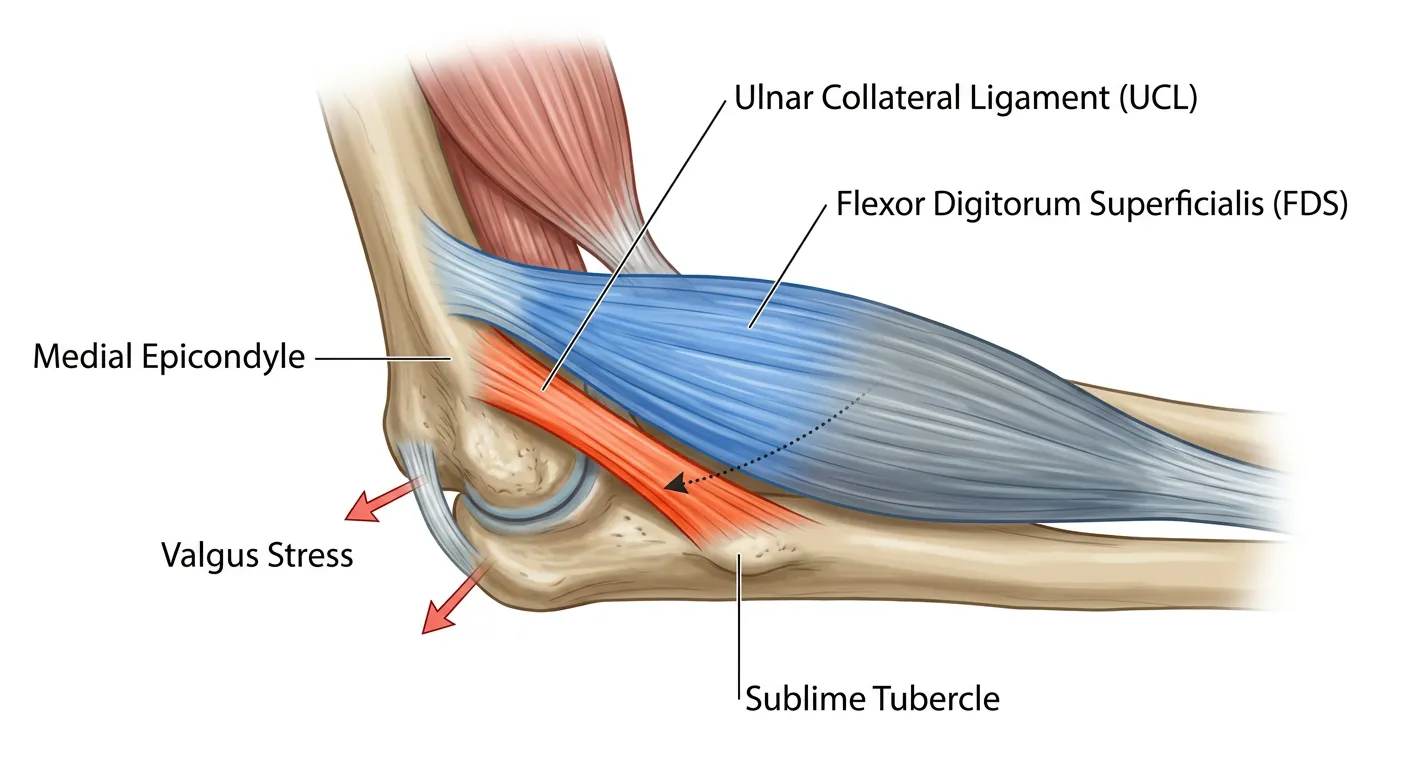 Medial elbow anatomy showing the UCL in red-orange and the flexor digitorum superficialis (FDS) in blue overlaying it — as the FDS fatigues distally, valgus stress transfers directly to the UCL.
UCL insufficiency does not always announce itself with a dramatic pop. More often, it presents as a slow fade. Velocity drops a tick. Then another. The arm feels heavy, the ball has no life, the pitcher chalks it up to dead arm and takes a few days off. It comes back, but not all the way. Greenberg et al. (2025) shows that velocity suppression begins roughly 9 games before acute UCL rupture — a gradual decline of about 0.1 mph per game on the fastball. By the time the acute injury happens, the ligament has been degrading for weeks.
What makes this dangerous is that the early symptoms overlap almost perfectly with workload-based dead arm. The difference is that workload-based dead arm resolves with appropriate rest and load management. UCL insufficiency does not. It might feel slightly better after a few days off, but the velocity never fully returns, and the symptoms come back as soon as the athlete ramps back up.
The tissue-level mechanism here is where the FDS fatigue research becomes relevant. Mukohara et al. (2024) showed that the flexor digitorum superficialis — the primary dynamic stabilizer of the medial elbow — nearly doubles in stiffness after 100 pitches and stays elevated for 24-plus hours. When the FDS is locked in that fatigued, non-responsive state, it cannot absorb valgus load in real time, and more stress passes directly to the UCL. Mullaney et al. (2025) found that 56% of pitchers showed greater than 20% loss in middle finger flexion strength by the fourth inning — and that high-torque pitchers lost twice as much as low-torque pitchers. The dynamic protection system degrades with every pitch, and the UCL picks up the slack until it cannot.
The red flags that separate UCL insufficiency from other types of dead arm: sharp or localized pain on the medial elbow during acceleration, a sensation of the elbow "opening up" or giving way, and velocity decline that does not recover with rest. If any of those are present, stop guessing and get evaluated. Early identification of UCL pathology changes the timeline and the options dramatically.
The SLAP Lesion: The Original "Dead Arm"
Worth mentioning briefly because this is where the term comes from clinically. Burkhart et al. (2000) defined "dead arm syndrome" as sudden loss of arm speed during the acceleration phase caused by a Type 2 SLAP lesion — a tear of the superior labrum where the biceps tendon anchors. The mechanism is posterosuperior instability: the humeral head shifts in the socket during late cocking, the labrum fails to contain it, and the pitcher loses the ability to generate arm speed.
This presents differently from the other three types. It is typically a sudden onset during a throw — not a gradual fade over weeks. The pitcher feels the arm "go dead" mid-throw, not after the outing. Pain is usually deep in the shoulder, not at the elbow or in the hand. And it does not respond to workload management or postural correction because the problem is structural damage to the labrum.
SLAP-related dead arm needs imaging and usually needs a clinical evaluation to determine whether the tear is something that can be managed conservatively or requires surgical intervention. If a pitcher describes a sudden, mid-throw loss of arm speed with deep shoulder pain, this is the first thing to rule out.
How to Tell the Difference
Knowing these four types exist is only useful if you can differentiate between them. Rather than restating everything above, here are the key distinguishing features — the things that separate one type from another:
| Key differentiator | What rules it out | |
|---|---|---|
| Workload | Resolves with 2-4 days of appropriate rest. Grip strength and velocity fully recover between outings. | If rest fixes it, stop looking. |
| Functional TOS | Symptoms appear on low-volume days or during non-throwing activities (carrying bags, sustained overhead positions). Numbness/tingling in ring and pinky fingers. | If symptoms track cleanly with throwing volume, it is probably not TOS. |
| Structural TOS | Fails to respond to 6-8 weeks of targeted conservative management. Positive provocation tests (Roos, Adson, costoclavicular). Confirmed via diagnostic injection. | If scapular elevation training and nerve glides resolve it, the cause was functional, not structural. |
| UCL insufficiency | Medial elbow pain during acceleration. Sensation of the elbow "opening up." Velocity decline that is gradual, progressive, and does not recover with rest. | No numbness or tingling — that is nerve compression, not ligament failure. |
| SLAP lesion | Sudden, mid-throw loss of arm speed — not a gradual fade. Deep shoulder pain, not elbow or hand. Onset during acceleration phase. | Gradual velocity decline over weeks points away from SLAP and toward workload or UCL. |
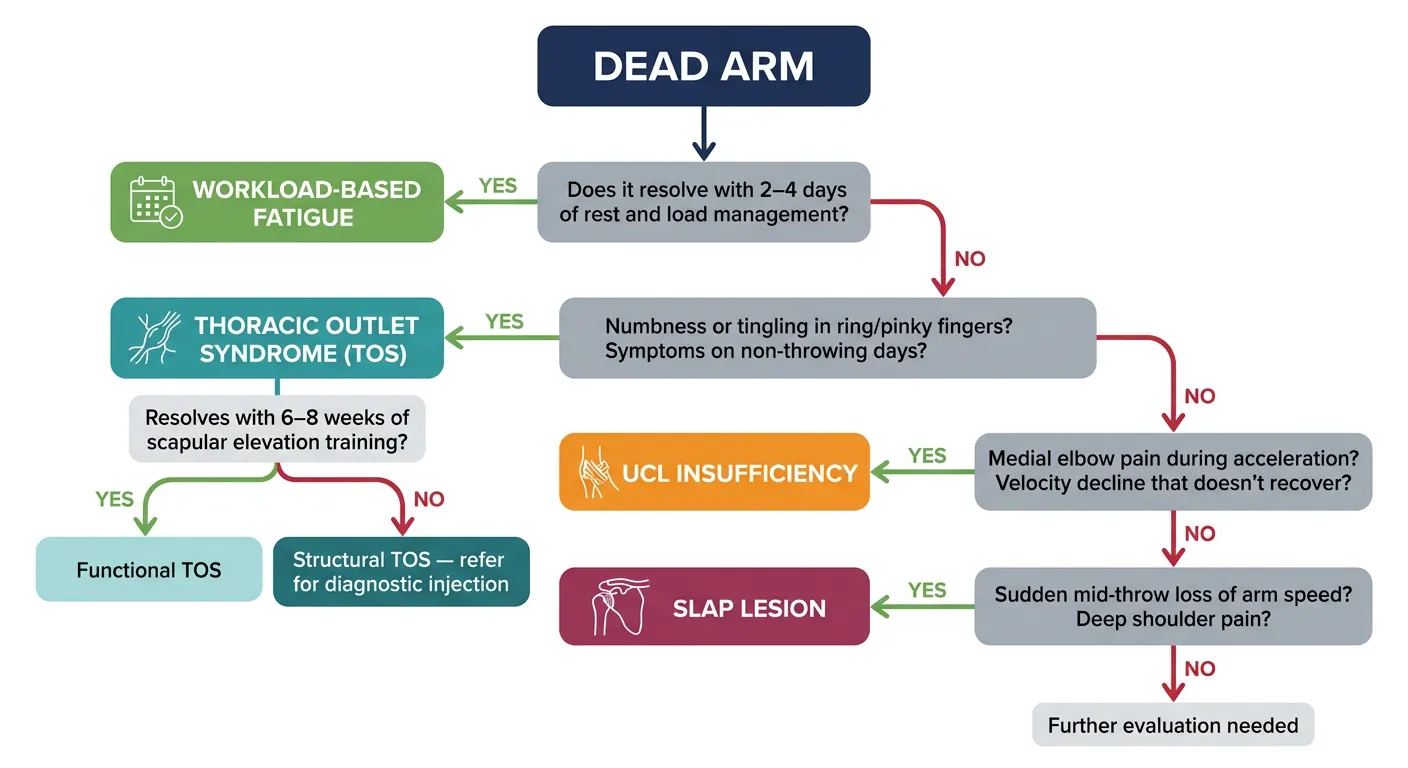 Dead arm differential diagnosis flowchart — a decision tree starting with rest response, then checking for numbness/tingling (TOS), medial elbow pain (UCL), and sudden mid-throw loss (SLAP), with a sub-branch for functional vs. structural TOS.
The practical starting point: manage workload first. If dead arm resolves with rest and appropriate load management, you have your answer. If it does not — or if it keeps coming back despite good workload practices — you need someone who can run a proper differential.
What to Do About It
If dead arm is not resolving with rest, stop resting and hoping. You need a differential diagnosis — someone who will systematically work through these four categories and identify the actual cause.
If you are a coach or trainer still cueing "shoulders down and back," the research on costoclavicular compression should give you pause. The upper trap is not the enemy — it is the muscle keeping the space open.
If you want to figure out what is actually going on with your arm, reach out. This is what we do — data-driven assessment and rehab for throwing athletes who need more than "just rest it."
THE NEXT STEP
See how we evaluate workload fatigue, shoulder capacity, nerve symptoms, and throwing readiness.
Explore Dead Arm RehabReady to talk? Book a free consultation →
RELATED POSTS
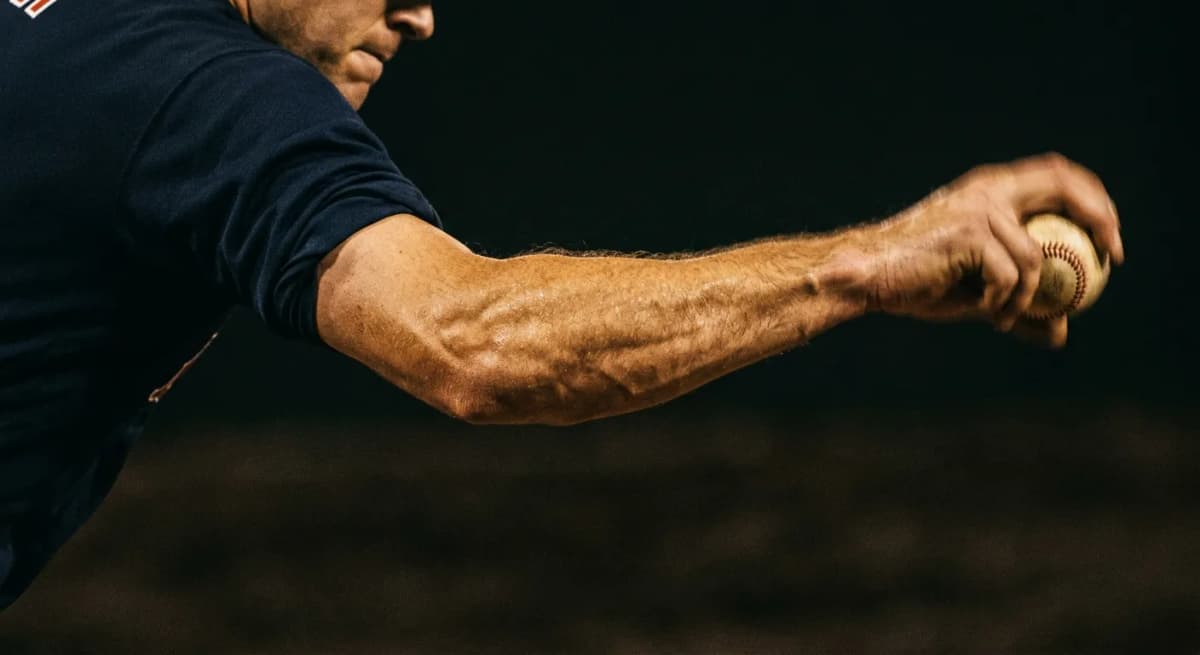
Your Muscles Fail Before Your UCL Does: The Deep Science of Tommy John
The UCL doesn't blow out in isolation. It fails when the muscles protecting it can no longer do their job — whether they yield from fatigue or lock from damage. Here's exactly what happens inside the elbow, pitch by pitch.
Read More →
Better Mechanics Won't Save Your UCL: Here's Why
"Fix his mechanics" is baseball's most common advice, and a logical fallacy. The research says tissue capacity and workload are what actually matter.
Read More →
Why Data-Driven Throwing Rehab Gets Better Results
Hope is not a return-to-throw strategy. Feel-based rehab ignores the metrics that predict re-injury. Here is what data-driven rehab actually tracks.
Read More →