THE ANKLE SPRAIN YOU'RE STILL PAYING FOR
The short version
A 'minor' ankle sprain is also a brain injury, a muscle inhibition problem, and the starting gun for osteoarthritis. The standard of care makes it worse.
By Dylan Newcomer, PT, DPT

You rolled your ankle. It swelled up, it hurt for a few days, you iced it, you taped it, you got back out there. Maybe you missed a game. Maybe you did not miss anything at all.
That was three years ago. And your ankle still does not feel right.
It is not that it hurts constantly. It is that it gives way at weird moments: a cut on the basketball court, a step off a curb, a landing that should have been routine. You do not trust it. You have started compensating without realizing it. And nobody has explained to you that the "minor" injury you forgot about is still running a tab on your body that compounds every year.
The lateral ankle sprain is the single most common traumatic injury in sport. It is also the most trivialized. And the gap between how we treat it and what the research says we should be doing is wider than almost any other injury in sports medicine.
The Numbers Nobody Takes Seriously
Here is what happens after a lateral ankle sprain if you follow the standard playbook of rest, ice, tape, and return to play when the pain is gone:
The recurrence rate of first-time lateral ankle sprains is 70%. Seven out of ten people who sprain their ankle will sprain it again. In professional football, Paget et al. (2025) found a recurrence rate of 25.6%, with severity directly influencing time loss and re-injury risk.
Approximately 40% of individuals who sustain an initial lateral ankle sprain develop chronic ankle instability within 12 months. Not a second sprain, chronic instability. A fundamentally different ankle than the one they had before the injury.
And a 2024 prospective cohort study found that athletes who returned to sport with a low Ankle-GO score (a composite measure of functional readiness) had a 9-fold increased risk of recurrence within two years. Nine times. The athletes who were "cleared" to return but had not actually restored function were almost guaranteed to re-injure.
These are not acceptable outcomes. If any other injury had a 70% recurrence rate, we would call the standard of care a failure. But because ankle sprains are "minor," the numbers get a shrug.
RICE Is Wrong
The standard acute ankle sprain protocol (Rest, Ice, Compression, Elevation) has been the default for decades. The evidence supporting it as a complete strategy is, to put it politely, insufficient.
A 2022 umbrella review of systematic reviews published in Frontiers in Medicine found little to no evidence supporting compression, ice, and elevation as treatments for acute ankle sprains. What they did find moderate evidence for was immediate post-traumatic mobilization. The opposite of rest.
Functional treatment (early weight-bearing, range of motion work, and graded loading) consistently outperforms immobilization on every metric that matters: time to return to activity, swelling reduction, joint stiffness, and both subjective and objective joint stability. Patients who had their ankles immobilized required more days missed from work and more follow-up visits compared to those who mobilized early.
The problem is not that rest has zero role. Immediately after the injury, some offloading is appropriate for pain management. The problem is that rest is where most ankle sprain treatment starts and ends. Ice it, stay off it, wait until it feels better, go back to playing. That is not a rehabilitation protocol. That is the absence of one.
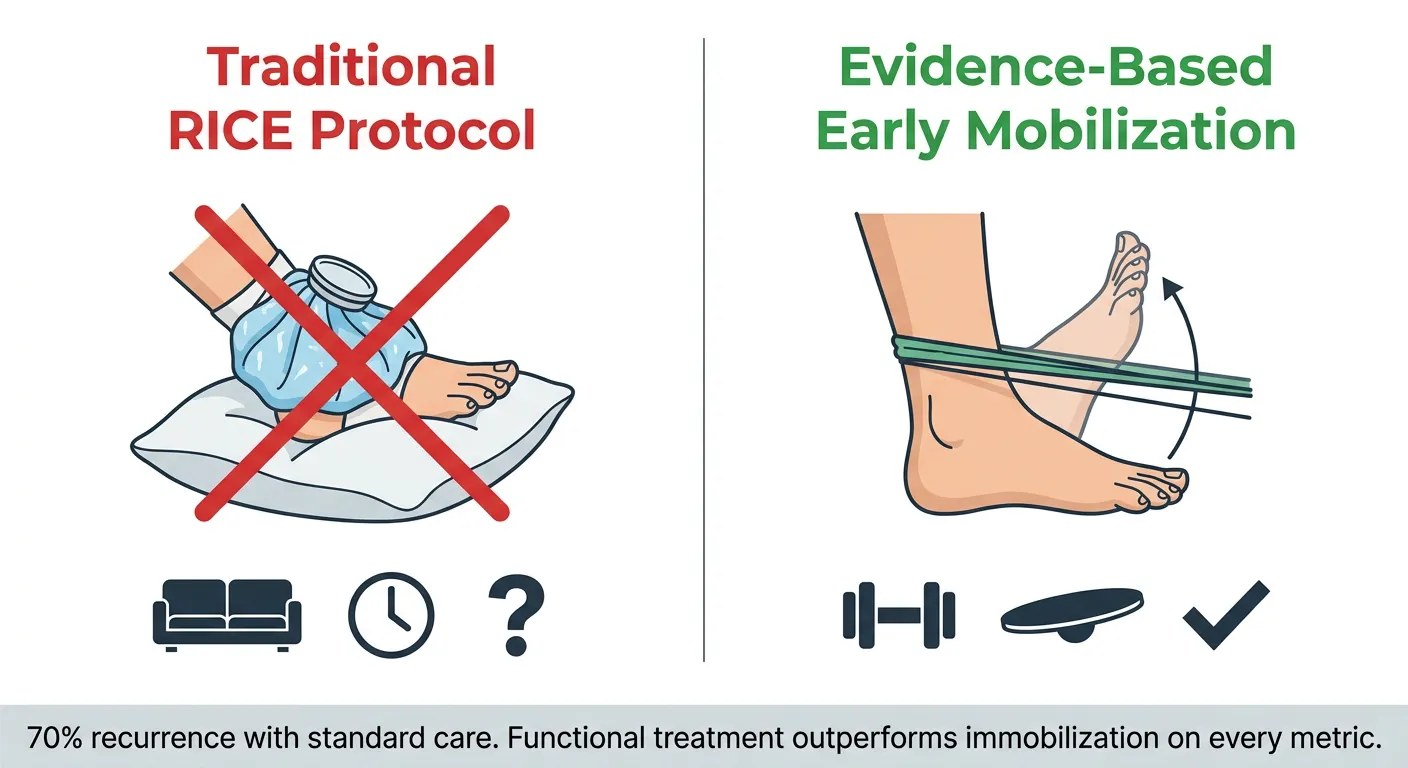 RICE protocol vs. evidence-based early mobilization, passive rest with a 70% recurrence rate versus active loading with structured progression.
The shift in the literature is clear: RICE should be replaced with something closer to what some clinicians call PEACE & LOVE, Protection, Elevation, Avoid anti-inflammatories, Compression, Education in the acute phase, then Load, Optimism, Vascularization, and Exercise in the subacute phase. The through-line is that passive rest is not recovery. Controlled loading is recovery.
Your Peroneals Are Asleep
Here is where the ankle sprain story starts to look a lot like the ACL rehab story.
The peroneal muscles (peroneus longus and brevis) are the primary dynamic stabilizers against ankle inversion. They are the muscles that are supposed to fire reflexively to prevent the exact mechanism that caused your sprain in the first place. And after an ankle sprain, they stop working properly.
Khalaj et al. (2024) published a cross-sectional study in Sports Medicine - Open examining arthrogenic muscle inhibition (AMI) in the peroneal muscles of people with chronic ankle instability. They found bilateral AMI, not just on the injured side, but on both sides. The affected limb had higher levels of inhibition, but the uninjured ankle was compromised too.
This is the same mechanism we see in the quadriceps after ACL injury. Joint damage triggers altered afferent signals, swelling and pain inhibit motor neuron activation at the spinal cord level. The muscle is structurally intact. It simply is not receiving the signal to fire at full capacity. Your peroneals are not weak because you have not done enough calf raises. They are inhibited because your nervous system is actively downregulating them in response to joint pathology.
Mendez-Rebolledo et al. (2024) took this further, showing that individuals with chronic ankle instability exhibit altered regional activation patterns within the peroneus longus during eversion. It is not just that the muscle fires less. It fires differently. The neuromuscular control strategy has been reorganized.
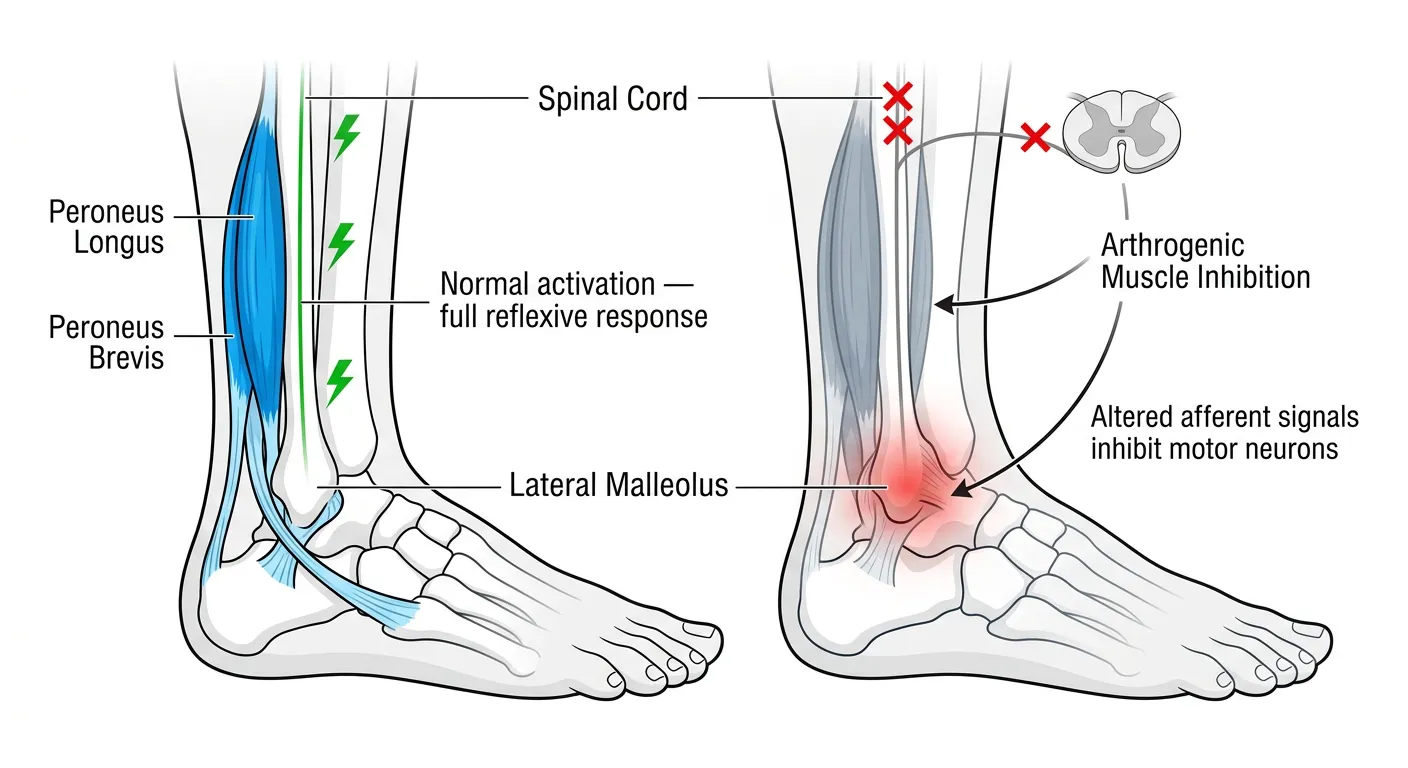 Peroneal arthrogenic muscle inhibition, a healthy ankle with normal nerve activation on the left versus a post-sprain ankle with altered afferent signals inhibiting motor neurons at the spinal cord level on the right.
And the downstream consequence is obvious: if the muscles responsible for preventing inversion are inhibited and firing with altered patterns, the ankle is mechanically unprotected during the exact movements that cause sprains. The ligament heals. The muscle inhibition persists. The next sprain is already loaded in the chamber.
It Is Also a Brain Injury
This is the part that should fundamentally change how you think about ankle sprains.
A 2023 systematic review in Sports Medicine examined brain neuroplasticity related to lateral ankle ligamentous injuries and found structural and functional brain adaptations in individuals with chronic ankle instability compared to healthy controls. These are not subtle findings.
Individuals with lateral ankle instability show reduced grey matter volume in the cerebellar vermis. The region of the cerebellum responsible for balance and postural control. The degree of grey matter reduction correlates positively with the duration of instability. The longer you have been living with a poorly rehabbed ankle, the more your cerebellum has physically changed.
Xue et al. (2024) used functional near-infrared spectroscopy to study cortical activation during single-leg stance in people with chronic ankle instability. They found increased sensorimotor cortex activation compared to healthy controls, and that increased activation correlated with poorer balance performance. The brain is working harder and producing worse results.
The mechanism: the first ankle sprain damages mechanoreceptors in the ligament. Kawabata et al. (2024) confirmed this directly. The number of mechanoreceptors in the ankle ligament is significantly reduced after injury, mechanosensitivity of sensory neurons decreases, and the degree of mechanoreceptor loss correlates with the severity of sensorimotor dysfunction. With fewer peripheral sensors sending accurate data, the central nervous system adapts. It shifts from relying on fast, unconscious proprioceptive processing to slower, conscious cortical processing. It increases visual dependence. It reorganizes motor strategies.
This is maladaptive neuroplasticity. The brain is not healing. It is compensating. And the compensations make the ankle less stable, not more. Alsalaheen et al. (2024) showed that individuals with unilateral chronic ankle instability present with impaired proprioception and delayed motor responses bilaterally, along with higher visual reliance and reduced ability to reweight sensory information.
Read that again. A sprain on one side is degrading sensorimotor function on both sides. The injury is not local. It is systemic, and it is happening in the brain.
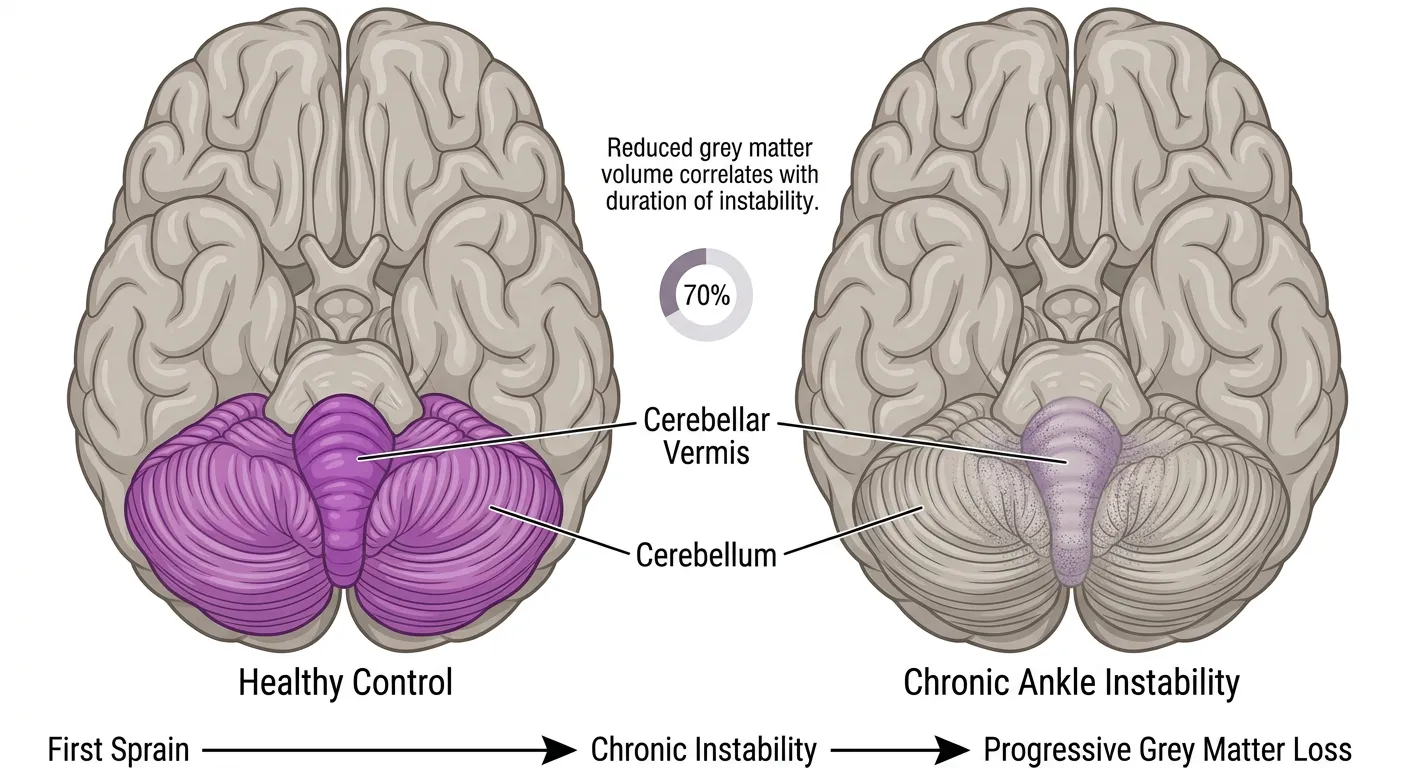 Cerebellar grey matter comparison, a healthy brain with full cerebellar vermis volume on the left versus chronic ankle instability with reduced grey matter on the right, with progressive loss correlating to duration of instability.
The Long Game Nobody Warns You About
If the immediate consequences of undertreated ankle sprains (recurrence, instability, muscle inhibition, neuroplastic changes) are not enough, here is the long-term picture.
Unlike most joints where osteoarthritis is primarily age-related, the majority of ankle osteoarthritis is post-traumatic. It does not come from wear and tear. It comes from injury. Specifically, it comes from the altered joint mechanics that follow inadequately rehabbed ankle sprains.
Chen et al. (2024) studied the effects of chronic ankle instability after even grade I sprains (the "mild" ones) on post-traumatic osteoarthritis development. The finding: untreated chronic ankle instability following a minor sprain leads to cartilage degradation and early osteoarthritic changes. Not from a severe injury. From the mild one you forgot about.
Whittaker et al. (2025) published a comprehensive review noting that ankle OA represents a growing clinical challenge, with post-traumatic cases developing over years to decades after the initial injury. And end-stage ankle osteoarthritis (the destination that a poorly managed sprain is slowly driving toward) produces disability comparable to end-stage kidney disease and congestive heart failure.
A "minor" ankle sprain, improperly managed, can put you on a 20-year path to a joint replacement. That is the price tag nobody quotes when they tell you to ice it and walk it off.
Why "Can You Jog On It?" Is Not a Return-to-Sport Test
The reason ankle sprain recurrence rates are so high is not that the injury is inherently unmanageable. It is that most athletes return to sport based on pain, not function.
The current evidence supports a criterion-based return-to-sport framework. Delahunt et al. (2021) led a multidisciplinary consensus that produced the PAASS framework, five domains that should be assessed before clearing an athlete to return:
Pain severity. Not just "does it hurt?" but pain during sport-specific movements and over the preceding 24 hours.
Ankle impairments. Range of motion, strength, endurance, and power - measured, not eyeballed.
Athlete perception. Perceived stability and psychological readiness. If the athlete does not trust the ankle, the ankle is not ready.
Sensorimotor control. Proprioception, dynamic postural control, performance on unstable surfaces, jump-landing quality, and reactive agility. This is where most return-to-sport protocols fall apart - they skip the neuromuscular assessment entirely.
Sport/functional performance. Hopping, cutting, agility drills, and the ability to complete a full training session without limitation.
A 2024 validation study of the Ankle-GO score (a composite tool based on these criteria) confirmed that athletes who scored poorly but returned to sport anyway had dramatically higher recurrence rates. The criteria work. The problem is nobody uses them.
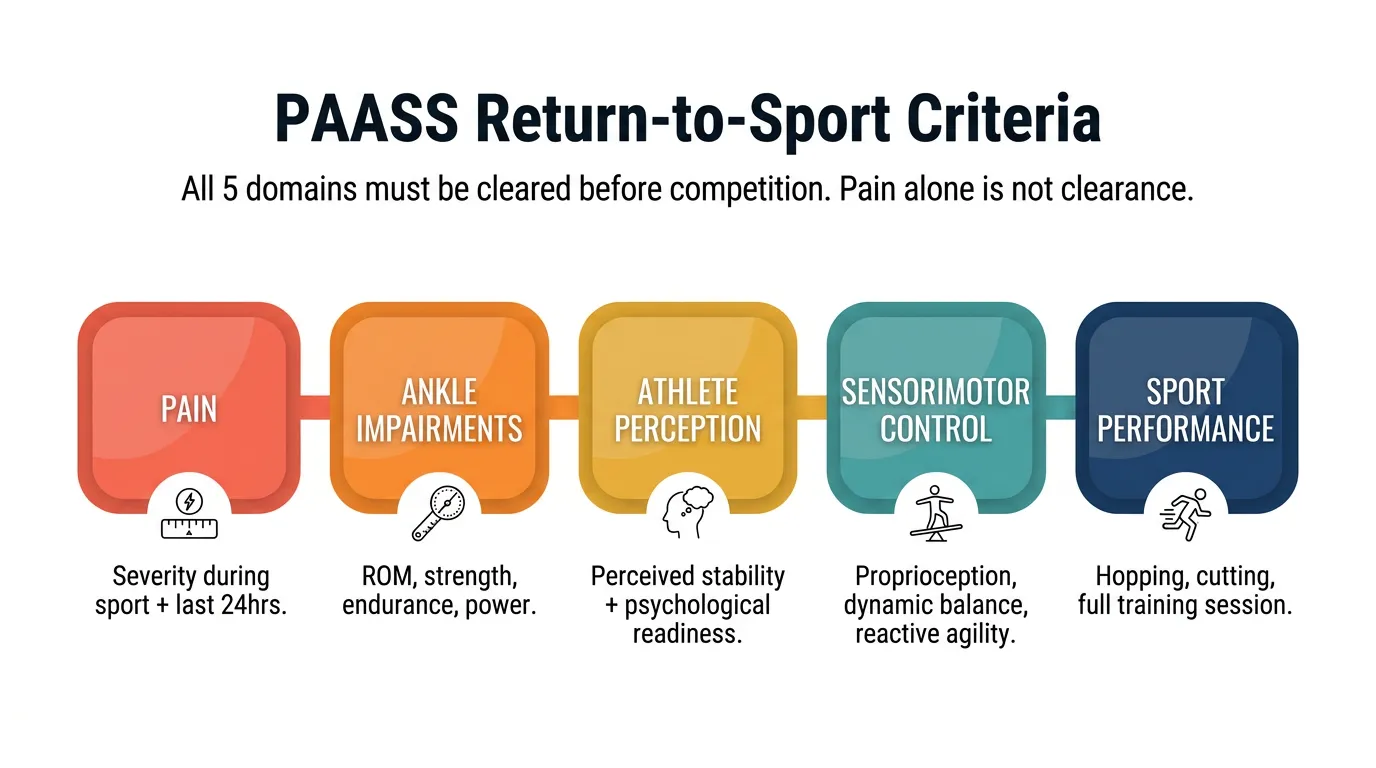 The PAASS return-to-sport framework, five domains that must all be cleared before competition: Pain, Ankle Impairments, Athlete Perception, Sensorimotor Control, and Sport Performance.
Compare this to the typical ankle sprain "clearance" in most settings: Can you walk? Does it hurt? Can you jog a bit? Great, you are cleared. That is not a return-to-sport test. That is a pain check. And pain is a terrible predictor of tissue readiness and neuromuscular function.
What Actual Rehab Looks Like
A 2025 meta-analysis in Scientific Reports reviewed 15 randomized controlled trials involving 586 participants and confirmed that exercise therapy is effective for chronic ankle instability, but the type of exercise matters. Long-term programs (over 4 weeks) that combined strength training, proprioceptive training, and joint mobilization significantly improved ankle function and dynamic balance. Short-term or single-modality programs did not.
A 2024 systematic review reinforced this: balance training alone improved functional outcomes, but the best results came from multimodal programs that combined balance, strength, proprioceptive training, and neuromuscular control.
Here is what that actually means in practice, broken into phases:
Phase 1: Acute Management (Days 1-7)
The goal is to manage swelling and pain while preserving as much range of motion as possible. Early weight-bearing as tolerated. Gentle ankle pumps and alphabet exercises for range of motion. Compression for swelling management. No prolonged immobilization unless there is a structural concern that warrants imaging.
What you are not doing: sitting on the couch with an ice pack waiting for it to feel better. Controlled movement starts immediately.
Phase 2: Restore Range and Activate Peroneals (Weeks 1-3)
Full weight-bearing gait without compensatory patterns. Restore dorsiflexion range of motion. The research consistently identifies dorsiflexion deficit as a predictor of recurrence. Active eversion exercises targeting the peroneals, starting with isometrics and progressing to isotonics. Calf strengthening in all planes. Single-leg stance on a stable surface, progressing to eyes-closed conditions to challenge proprioception without external instability.
The peroneal work matters because of AMI. You have to deliberately retrain a muscle that the nervous system has turned down. This does not happen passively. It requires targeted, progressive loading.
Phase 3: Neuromuscular Control and Strength (Weeks 3-8)
This is the phase that most ankle sprain rehab skips entirely. Single-leg balance progressions on unstable surfaces (foam pads, BOSU, rocker boards. Perturbation training) having someone or something challenge your balance unpredictably. Eccentric and concentric peroneal strengthening through full range. Hip and core strengthening, because proximal stability influences distal control, and research shows that people with CAI have altered hip muscle activation patterns.
The brain-level changes documented in the research mean that balance and proprioceptive training is not optional. It is directly addressing the maladaptive neuroplasticity that the injury created. You are not just rehabbing an ankle. You are retraining a brain.
Phase 4: Sport-Specific Loading and Return-to-Sport (Weeks 6-12+)
Progressive plyometrics: double-leg to single-leg, bilateral to unilateral, predictable to reactive. Cutting and change-of-direction drills at escalating speeds. Sport-specific movement patterns under fatigue. Full practice participation as the final test before competition clearance.
Return to sport is gated by the PAASS criteria, not by the calendar and not by pain levels.
Stop Treating It Like a Minor Injury
The lateral ankle sprain is not minor. The recurrence rate is 70%. The chronic instability rate is 40%. The injury causes measurable muscle inhibition, structural brain changes, bilateral sensorimotor deficits, and sets the stage for post-traumatic osteoarthritis decades later.
The standard of care (RICE and return when pain-free) is not just insufficient. It is producing outcomes so bad that if we applied the same standards we use for ACL rehab, we would call it malpractice.
If your ankle still does not feel right: if it gives way, if you do not trust it, if you have sprained it more than once, you need someone who will actually assess what is wrong and build a program to fix it. Not tape. Not a brace. Not "strengthening exercises" printed on a sheet of paper. A systematic, criterion-based rehabilitation program that addresses the muscle inhibition, the sensorimotor deficits, and the neuromuscular control problems that the injury created.
Your ankle has been sending you the bill for years. It is time to pay it off the right way.
THE NEXT STEP
See how we rebuild ankle strength, control, and tolerance for cutting, running, and sport.
Explore Ankle Sprain RehabReady to talk? Book a free consultation →
RELATED POSTS

Why Your Hamstring Keeps Coming Back
You strained your hamstring. You rested. You stretched. It came back. Standard rehab misses the three mechanisms that actually drive recurrence.
Read More →
ACL Rehab Timeline: What Athletes Need to Know
Most ACL timelines are based on the calendar. The research says that's wrong — and it's why 1 in 4 young athletes re-tear. Here's what actually matters.
Read More →